
HiLetgo 3pcs ESP8266 ESP-01
4.2Editor score
3pcs Pack Included
AP STA Modes
Arduino Compatible
Compare the top Arduino WiFi Module options for connectivity and performance in our expert guide covering features, specs, and real-world project compatibility.
Choosing the right Arduino WiFi Module is essential for connecting your projects to the internet. Whether you are building smart home devices or industrial sensors, reliable wireless communication matters. This guide highlights the best options available today.
We evaluated each module based on connectivity standards, processing power, ease of use, and community support. Our list includes boards with built-in wireless chips and add-on modules. We focused on versatility for makers and professionals alike.
Each pick demonstrates specific strengths for different project needs and budgets. You will find options ranging from compact transceivers to full-featured development boards. Please note that prices and availability may change over time.
4.2Editor score

4.7Editor score

4.5Editor score
This side-by-side comparison helps you visualize key differences across all ten selected products. Review the specifications to find the module that best fits your specific project requirements and technical needs.



The Arduino UNO R4 WiFi stands out as the top overall choice for advanced IoT projects. It combines a powerful dual-core architecture with reliable wireless connectivity out of the box. This board is ideal for users who need robust processing and seamless cloud integration.
We may earn a commission when you buy through this link, at no additional cost to you.
Its combination of the Renesas RA4M1 and ESP32-S3 chips offers exceptional flexibility. You can handle complex logic on one core while managing Wi-Fi and Bluetooth on the other. The integrated 12×8 LED Matrix provides instant visual feedback without extra components.
While it is more expensive than basic modules, the added features justify the cost. The USB-C port simplifies connections and the Qwiic connector reduces wiring complexity. These conveniences save significant time during prototyping and deployment phases.
We recommend this board for developers seeking a complete solution. It suits smart home systems, industrial sensors, and educational projects. If you need high performance and modern interfaces, this is the strongest pick available.
The dual-core setup allows for parallel task execution. This ensures smooth operation even when running heavy network tasks.
The LED Matrix allows you to display status or data immediately. This removes the need for external displays in many cases.
We may earn a commission when you buy through this link, at no additional cost to you.
The HiLetgo ESP8266 ESP-01 is the best budget-friendly option for basic wireless needs. It offers essential WiFi capabilities at a minimal cost. This is perfect for hobbyists who need simple connectivity without breaking the bank.
We may earn a commission when you buy through this link, at no additional cost to you.
It supports three distinct WiFi modes allowing flexible network setups. You can connect as a client or create your own hotspot. The module is small enough to fit into tight spaces in portable devices.
Keep in mind that it lacks native USB-C or voltage regulation features. You may need external level shifters or power regulators for 5V systems. This adds a small amount of complexity to the build process.
Choose this module if your priority is low cost and simplicity. It works well for sensor nodes where size and price are critical factors. Just ensure you have the necessary adapters for your main board.
This module provides essential WiFi features at a low cost. It is ideal for batch projects or testing setups.
You can operate in station or access point mode. This versatility helps with various network topology designs.
We may earn a commission when you buy through this link, at no additional cost to you.
The Arduino Nano ESP32 brings premium capabilities to a compact form factor. It supports MicroPython and HID profiles for advanced interaction. This makes it a top pick for developers who value modern software ecosystems.
We may earn a commission when you buy through this link, at no additional cost to you.
Its ESP32-S3 chip provides high processing power and strong wireless connectivity. The USB-C port ensures fast data transfer and reliable power delivery. You can create custom input devices like keyboards using its HID support.
Note that this board often comes without pre-soldered headers. You will need to solder them to plug it into a breadboard. This step adds a minor hurdle but is common for compact development boards.
This board is perfect for users who want high-end features. It suits smart interfaces, wearables, and connected devices. If you prefer Python or need HID support, this is the best choice.
You can program this board using Python for rapid prototyping. This simplifies coding for those already familiar with Python syntax.
The board can act as a keyboard or mouse. This opens up possibilities for custom remote controls and interfaces.
We may earn a commission when you buy through this link, at no additional cost to you.
The ESP8266 ESP-01S improves on the original with better signal strength. It includes 4MB flash for larger sketches. This makes it reliable for projects needing more storage or range.
We may earn a commission when you buy through this link, at no additional cost to you.
Its compact size fits easily into tight enclosures. You can use it in handheld devices or wearables. The generic ESP8266 setting in Arduino IDE simplifies programming for most users.
Be aware that the small footprint requires careful handling. You might need a breakout board for easier prototyping. This adds a small cost but protects the pins during experimentation.
Choose this module if you need better range than the basic version. It is a solid upgrade for home automation projects. It balances performance and size effectively for many applications.
This version features stronger signal output than older models. You will see better connection stability in crowded networks.
With 4MB flash you can store more code and data. This supports features needing file storage or logging.
We may earn a commission when you buy through this link, at no additional cost to you.
The Aitrip 5pcs ESP8266 offers excellent value for bulk projects. Getting five modules reduces the cost per unit significantly. This is ideal when building multiple sensors or nodes for a larger system.
We may earn a commission when you buy through this link, at no additional cost to you.
It uses the standard ESP8266 core with 1MB flash memory. The 3.3V logic means you must handle voltage carefully. Most Arduino boards require a level shifter for direct connection.
The pack allows you to distribute replacements across several builds. If one fails you have spares ready immediately. This is crucial for distributed systems where maintenance is difficult.
Opt for this kit if you plan to deploy many devices. It keeps the per-unit cost low. Ensure you have the correct power supply and voltage regulators in place.
Buying five units lowers the overall expense per module. This is smart for school labs or mass deployment.
The module uses 3.3V logic. You will need to adapt signals for 5V systems like Uno.
We may earn a commission when you buy through this link, at no additional cost to you.
The ELEGOO ESP-32 Dev Boards provide dual core power in a compact pack. Three boards are included allowing easy setup for multi-node systems. It supports USB-C for modern connection needs.
We may earn a commission when you buy through this link, at no additional cost to you.
Running at 240 MHz it handles complex tasks efficiently. Bluetooth 4.2 and BLE enable wireless communication options. OTA updates allow you to change firmware over Wi-Fi remotely.
While the packaging is great, check if headers are included. Some versions may require you to solder connectors for breadboards. This is a standard practice for many standalone ESP32 boards.
This set is a great choice for scalable projects. You can test with one and deploy two more. The low power modes support battery-powered sensors well.
OTA updates let you fix bugs without physical access. This is key for deployed IoT devices.
Dynamic clock scaling helps save battery. It is useful for remote sensing nodes.
We may earn a commission when you buy through this link, at no additional cost to you.
This pack of four ESP8266 ESP-01S modules is calibrated for performance. You get reliable connectivity right out of the box. The self-calibrated RF ensures stable operation in various environments.
We may earn a commission when you buy through this link, at no additional cost to you.
The materials are durable enough to be reused across projects. This saves money on long-term prototyping and testing. It fits well in wearable electronics and compact sensors.
Handling these small modules requires care to avoid bent pins. Using a holder or adapter can prevent damage during use. This is standard when working with pinhead-sized components.
Choose this pack for reliable network nodes. It suits home automation where multiple devices are needed. The calibration gives you confidence in the radio performance.
The modules come with self-calibrated RF settings. This reduces signal loss and improves consistency.
You can reuse these modules in different projects. This flexibility is good for learning and iteration.
We may earn a commission when you buy through this link, at no additional cost to you.
This 5-unit pack of ESP8266 ESP-01S modules provides ample storage. Each unit has 4MB flash for code and data. This helps when you need to store configuration or logs.
We may earn a commission when you buy through this link, at no additional cost to you.
The DOUT protocol ensures compatibility with various bootloaders. You can program them easily using the generic board setting. High baud rates allow fast serial communication with PCs.
Since they are 3.3V you must ensure power is limited correctly. Using 5V will damage the unit. Check your power supply before connecting directly to any port.
This bundle is great for building sensor arrays. You can place units in different spots for full coverage. The storage allows for robust local data handling.
4MB flash lets you store larger files. This helps with data logging projects.
Support for high baud rates speeds up serial data. This is useful for logging or real-time updates.
We may earn a commission when you buy through this link, at no additional cost to you.
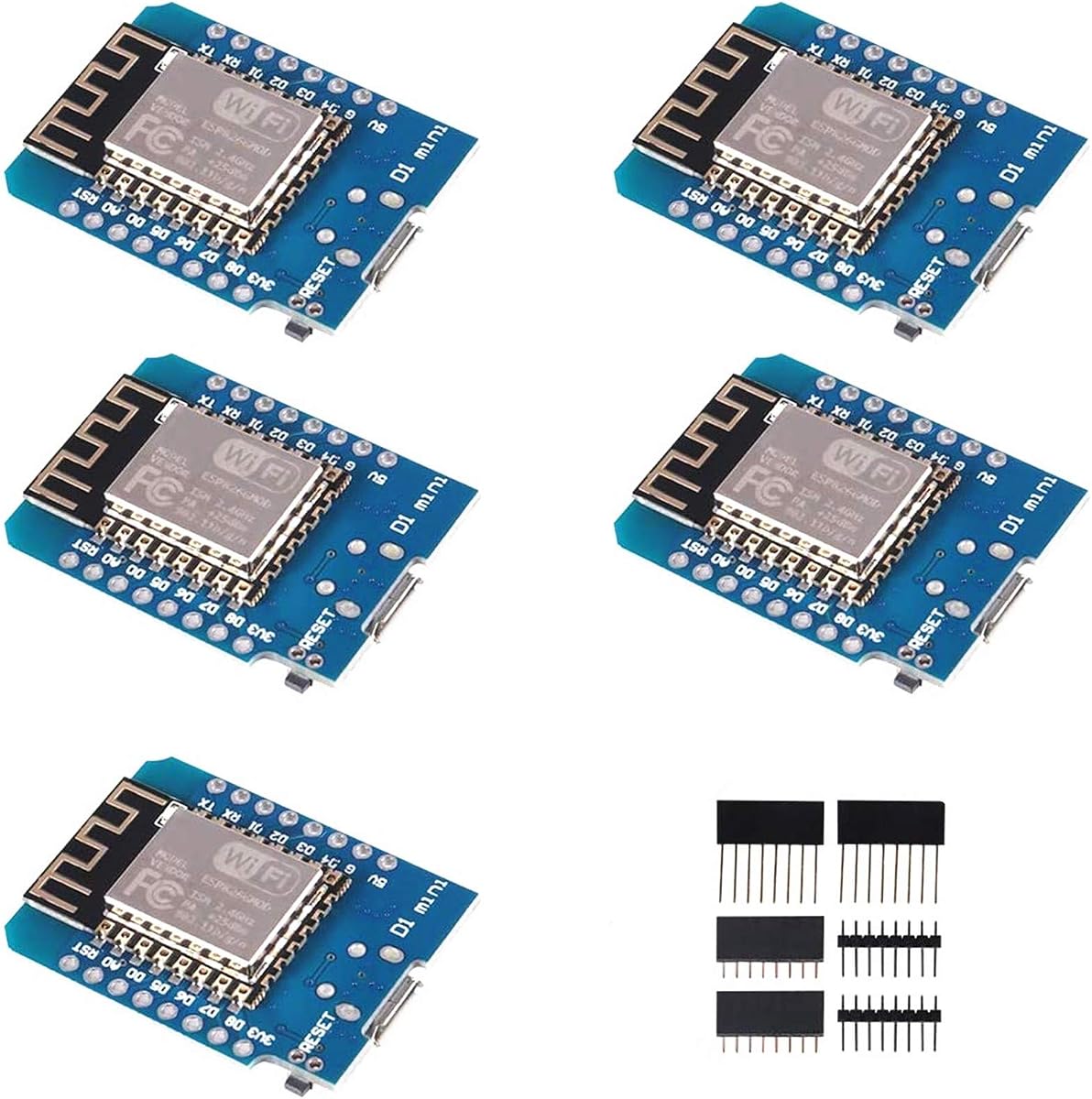
The ESP8266 ESP-12F NodeMcu Mini D1 Module is a compact board. It brings out most pins for direct use. This avoids the need for breakout boards in many cases.
We may earn a commission when you buy through this link, at no additional cost to you.
It features 11 digital pins plus analog input. The integrated switch allows easy USB connectivity. You can program it via Arduino IDE or Lua for quick scripts.
The form factor is smaller than typical WiFi shields. It fits in wearable devices or small boxes. This saves space when you need connectivity in tight spots.
Choose this board for pin-rich projects. It is great for complex sensors or controls. Ensure your power supply supports the onboard switching.
11 digital pins give you many options for sensors. This reduces the need for expanders.
Lua support allows fast prototyping. It is useful for simple logic tasks.
We may earn a commission when you buy through this link, at no additional cost to you.
This 10-pack offers maximum value for large scale setups. You get ten functional WiFi transceiver modules for a low price. It is perfect for classrooms or factory deployments.
We may earn a commission when you buy through this link, at no additional cost to you.
Each module supports LWIP for efficient network tasks. The processing and storage capabilities are robust. This allows for complex network algorithms or data handling.
Keep in mind the small physical dimensions. You will need breakout boards or soldering for ease. This is standard for this type of transceiver module.
Pick this pack if volume matters most. It covers extensive networking projects with spare parts. The high rating confirms reliability across units.
LWIP support optimizes network stacks. This helps with bandwidth usage.
Ten units provide ample stock. You can replace or expand networks without reordering.
We may earn a commission when you buy through this link, at no additional cost to you.
Selecting the right module depends on your project requirements and constraints. Here are key factors to consider before purchasing.
Check which Wi-Fi and Bluetooth standards are supported. Look for 2.4 GHz for broad compatibility. Bluetooth 5.0 offers better power and range.
Prioritize modern protocols for future-proofing your designs.
Evaluate the CPU speed and core count. Dual-core processors handle multitasking better than single-core ones. This matters for complex logic or edge computing.
Choose higher performance for demanding applications.
Battery projects need low-power modes. Check the current draw in sleep states. Modules with dynamic scaling save energy effectively.
Select low-power options for remote sensing.
Consider how much memory is available. More flash allows larger code and data logs. ESP8266 modules vary from 1MB to 4MB.
Opt for higher storage for feature-rich apps.
Look for USB-C for modern connection standards. Micro USB is still common but less durable. Check if headers are included or need soldering.
USB-C improves durability and power delivery.
Most modules run on 3.3V logic. Ensure your main board matches or use shifters. Do not feed 5V directly to 3.3V modules.
Verify voltage levels before connecting.
Check for Arduino IDE compatibility and library support. Some boards support MicroPython or Lua. Good documentation speeds up development.
Pick boards with strong community resources.
Review if an antenna is onboard or external. PCB antennas save space but may have less range. External antennas help in metal enclosures.
Ensure antenna range matches your use case.
Connect your module to a stable 3.3V power source. Ensure logic levels match your controller board. Use a multimeter to verify voltage before powering up.
Keep the module away from metal shields that might block signal. Use plastic cases or ensure an antenna connection. Avoid bending pins too much during insertion.
Store unused modules in static-safe bags. Humidity and heat can damage electronics. Check for oxidation on pins before using older stock.
Most modules like the ESP8266 run on 3.3V logic. If you connect to a 5V board like the Uno, use a level shifter to avoid damage. Ensure power is also regulated to 3.3V for safety.
ESP32 boards are faster with dual-core processing and Bluetooth support. ESP8266 is simpler and cheaper but lacks native Bluetooth. Choose ESP32 for more power and ESP8266 for basic needs.
Yes, many modules do not have built-in USB. You can use serial adapters like FTDI to program them. Alternatively, use a board that integrates the USB interface like the Nano ESP32.
Open the Arduino IDE and go to the Library Manager. Search for the specific library for your module. Click Install. Some boards require a board manager URL to be added first.
Consumer grade modules work in light industrial settings. Check for operating temperature ranges and shielding requirements. For harsh environments, ensure proper voltage protection and robust housing.
Typical range is 30 to 100 meters outdoors. Obstacles like walls reduce this significantly. Use an external antenna if you need longer distances.
Our top three picks cover the main needs for modern connectivity. The Arduino UNO R4 WiFi leads in features and performance. The HiLetgo ESP8266 is ideal for tight budgets.
When choosing, prioritize processing power and voltage compatibility. Ensure your setup can handle the logic levels safely. Look for modules that match your specific project constraints.
Always check the latest prices before buying. Availability can shift based on market demand. This guide provides a solid starting point for your selection.
