
WWZMDiB 5 Pcs Power Supply Module
4.2Editor score
Compatible with 400 and 830 points
Input 6.5 to 12V DC or USB
Includes 5 Pcs 9V Connector
This guide compares the top 12V breadboard power supplies for makers, covering voltage options, current limits, and compatibility with common prototyping
Choosing the right power supply is crucial for any electronics project involving breadboards. A stable 12V input converted to reliable 3.3V and 5V outputs ensures your microcontrollers and sensors function correctly without damage or erratic behavior.
We evaluated ten leading options based on versatility, current capacity, build quality, and ease of use. Our selection includes standard modules, comprehensive kits, and advanced adjustable units suitable for everything from simple LEDs to complex IoT systems.
Each review highlights key specifications, pros, cons, and ideal use cases to help you decide. Keep in mind that product availability and pricing can change frequently, so always verify details before making your final purchase decision for your workshop.
4.2Editor score

4.5Editor score

4.8Editor score
The following table provides a side-by-side comparison of all ten selected power supply modules. It highlights key specifications like input ranges, output voltages, and unique features to help you quickly identify the best match for your prototyping needs.



This 2-pack module stands out as the Editor's Choice due to its versatility and robust feature set. With a rating of 4.5 stars, it balances performance and value exceptionally well for hobbyists. The dual power input versatility allows you to use either a Type-C USB cable or a classic DC jack, making it adaptable to various power sources you might have on hand.
We may earn a commission when you buy through this link, at no additional cost to you.
The independent right and left channel control is a standout feature that sets this apart from simpler models. You can run one side of your breadboard at 3.3V for sensitive sensors while the other side runs at 5V for logic or motors. The visual status indicators ensure you always know which rails are active, preventing accidental shorts or power confusion during complex wiring sessions.
While the current output of 5V at 2A is sufficient for most Arduino and Raspberry Pi projects, it is lower than high-end industrial supplies. However, for breadboard prototyping, this limit protects components from drawing too much power. The concave design ensures a flush fit on the board, preserving precious tie-points for your components and wires.
Ultimately, this module is ideal for makers, students, and engineers who need reliable power for daily prototyping. Whether you are building a simple LED circuit or a complex IoT node, the protection features and independent control provide peace of mind. We recommend this as your go-to power solution for standard breadboard work.
Supports both modern Type-C USB and classic DC 6-12V jack inputs for convenient prototyping power sources.
Features independent switches for left and right rails allowing simultaneous 3.3V and 5V operation.
We may earn a commission when you buy through this link, at no additional cost to you.
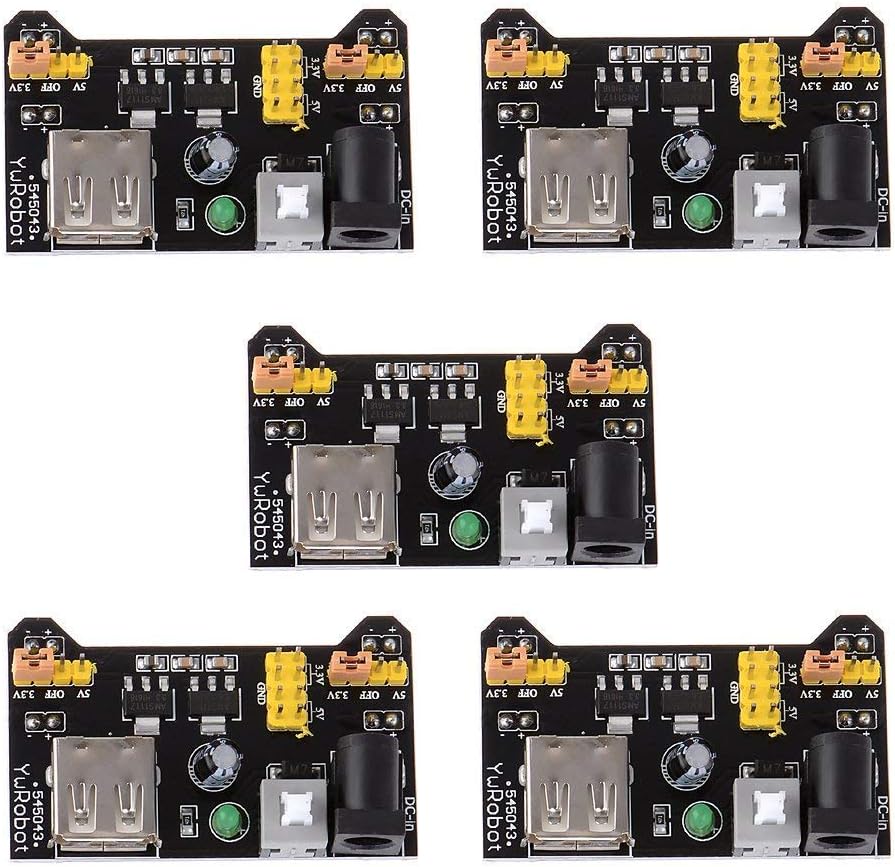
For budget-conscious builders who need multiple units, this 5-piece set offers excellent value. The rating of 4.2 reflects its reliability for standard tasks. It is designed specifically to work with 400-point and 830-point solderless breadboards, ensuring a secure fit without additional wiring. This makes it an ideal starter pack for classroom sets or group projects where multiple students need individual power sources.
We may earn a commission when you buy through this link, at no additional cost to you.
The module supports a wide input voltage range of 6.5 to 12V DC or USB, giving you flexibility in how you power your station. The output provides stable 3.3V or 5V DC, which covers the requirements for most microcontrollers like Arduino and ESP8266. Including five 9V connectors in the package adds practical value, allowing you to quickly switch between battery packs or wall adapters.
However, the maximum output current is capped at below 700mA, which is standard for these modules but limits high-power applications like driving multiple servos. If you need more current, you might need to look at switching regulators. Despite this, for simple circuits and sensor testing, the cost per unit is hard to beat.
We recommend this kit for schools, classrooms, or makers who need spare power modules on hand. The bulk packaging ensures you never run out of a module mid-project. For general prototyping where cost is a primary concern, this set provides reliable performance at an unbeatable price point.
Five units per pack offer excellent value for classrooms or workshops needing multiple power modules.
Designed for 400-point and 830-point solderless breadboards with included 9V connectors.
We may earn a commission when you buy through this link, at no additional cost to you.
This kit is designed to provide a complete starting point for Arduino and Raspberry Pi projects. With a 4.0 rating, it offers a straightforward solution that includes everything needed to get running immediately. The package contains an 830-point solderless breadboard, the power module, jumper wires, and a dedicated 12V 1A adapter to ensure project stability.
We may earn a commission when you buy through this link, at no additional cost to you.
The power module itself allows for independent control of two ways, switching between 5V, 3.3V, or off. Input options support both 6.5-12V DC and USB, providing versatility for different setups. The included 65 colorful jumper wires are convenient for connecting modules quickly without searching for loose components in your storage box.
While the adapter provides stable 12V power, the module limits current to 700mA, which is suitable for logic-level circuits but not heavy loads. This makes it perfect for students learning electronics where safety and simplicity are prioritized. The breadboard size is standard, fitting easily on most workbenches or desks.
We recommend this kit for beginners who want a full setup without buying individual parts separately. It eliminates the guesswork of matching components and adapters. For educational purposes or initial prototyping, having all compatible pieces in one box streamlines the learning process significantly.
Includes breadboard, power module, jumpers, and adapter for immediate project setup.
Comes with a dedicated 12V 1A adapter to ensure reliable voltage for your circuits.
We may earn a commission when you buy through this link, at no additional cost to you.
HiLetgo is a known brand in the electronics component space, and this 5-piece pack reflects that reliability. With a 4.3 rating, these modules are designed specifically for MB102 prototype breadboards, ensuring a snug and secure connection. The input voltage range of 6.5 to 12V DC or USB allows you to connect directly to standard power supplies or laptops.
We may earn a commission when you buy through this link, at no additional cost to you.
The output voltage options of 3.3V and 5V cover most common microcontroller needs. Onboard pins allow for easy connection to your circuits. The maximum output current is capped at 700mA, which is safe for testing and small devices but may require external power for motors. This safety limitation helps protect sensitive components from damage.
While it lacks the advanced features of newer models like dual independent channels, it excels in simplicity and cost-effectiveness. The 5-pack means you can distribute modules across different workstations or keep spares handy for future projects. The design is compact, leaving more room on the breadboard for your actual components.
We recommend this option for users who prioritize brand reliability and straightforward functionality. If you are already using MB102 boards and need a trusted power source without extra frills, this is a solid choice. The quantity included makes it practical for team environments or hobbyists with multiple projects running simultaneously.
Designed specifically to fit MB102 prototype breadboards securely.
Space-saving profile leaves more room for components on your prototyping board.
We may earn a commission when you buy through this link, at no additional cost to you.
With a rating of 4.6, this module stands out for its reliability and seamless integration with various boards. It is designed for MB102 prototype breadboards but is widely compatible with Arduino, Raspberry Pi, and ESP32. The dual voltage output of 3.3V and 5V ensures you have the right power for your specific device components without needing extra regulators.
We may earn a commission when you buy through this link, at no additional cost to you.
Flexible power options include input from 6.5 to 12V DC or via USB, making it suitable for both bench work and mobile prototyping. The solderless design means it plugs directly into the breadboard rails without any soldering required. This convenience saves time and makes it perfect for beginners and experienced users alike who value quick setup.
Built with high-quality components, it ensures efficient power distribution which helps maintain stability in your electronic designs. The module handles voltage regulation well, reducing noise and interference that could affect sensors. While it is sold as a single unit, its quality often justifies the focus on performance over bulk quantity.
We recommend this for users who want a dependable power source for high-end microcontrollers. If your project involves sensors that are sensitive to power quality, this module's efficiency is beneficial. For general use where reliability is key, this module offers a solid balance of performance and ease of use.
Built with high-quality components to ensure efficient and stable power distribution.
Seamless integration with MB102 breadboards and popular boards like ESP32.
We may earn a commission when you buy through this link, at no additional cost to you.
This bulk pack offers excellent value for workshops needing multiple power supplies. The rating of 4.5 indicates strong performance and user satisfaction. Designed for 400-point and 830-point solderless breadboards, it plugs directly into the rails for a quick setup. The dual voltage output allows selection between 3.3V and 5V via a yellow jumper.
We may earn a commission when you buy through this link, at no additional cost to you.
The intuitive operation features an ON/OFF self-locking switch and a green LED indicator for power status. This makes it easy to monitor which rails are active without needing a multimeter. The fixed regulated output ensures stability, which is sufficient for most electronic projects and learning purposes. It is simple to operate: just plug in and select voltage.
Five 9V battery quick-connect cables are included, allowing for battery power without extra purchases. This flexibility is useful for portable prototypes or testing outside the lab. However, the maximum output current is below 700mA, so it is best suited for general circuit experiments rather than high-current motors or displays.
We recommend this set for educational environments or shared workspaces. The bulk packaging ensures availability for multiple users simultaneously. For hobbyists who need spares or a dedicated power module for different projects, this is a practical and cost-effective solution that simplifies breadboard setup.
Features an ON/OFF self-locking switch and green LED indicator for easy monitoring.
Includes 5 9V battery quick-connect cables for portable power solutions.
We may earn a commission when you buy through this link, at no additional cost to you.
This DIY kit is designed for advanced users who want flexibility and visual feedback. With a rating of 4.1, it appeals to makers who enjoy building their own power solutions. The LM2596 module supports fixed outputs of 3.3V, 5V, and 12V, plus an adjustable output for testing varied voltage requirements. A built-in display shows the actual output level.
We may earn a commission when you buy through this link, at no additional cost to you.
The all-in-one design integrates multiple outputs, reducing the need for separate regulators and repeated rewiring. It helps minimize wiring errors that can damage components, centralizing power control in one safe board. The optional negative voltage support makes it suitable for analog circuits that require dual rails, a feature often missing in basic modules.
However, this kit requires soldering skills to assemble, which may not suit beginners looking for plug-and-play simplicity. The setup time is longer, and careful attention is needed during construction to avoid mistakes. Once built, it offers a cleaner and safer way to power complex experiments compared to temporary connections.
We recommend this for electronics labs, workshops, and advanced makers. If you frequently work with diverse circuits and want precise control over voltage levels, this module is ideal. The visual confirmation of voltage settings provides confidence during setup and testing, making it a valuable tool for serious hobbyists.
Built-in digital display allows you to visually confirm voltage settings before connecting.
Supports optional negative voltage for analog circuits and advanced experiments.
We may earn a commission when you buy through this link, at no additional cost to you.
The BreadVolt module by SunFounder is built to handle higher current demands. With a rating of 4.5, it offers 5V at 1.5A and 3.3V at 1A, making it suitable for powering more demanding devices than standard 700mA modules. It is compatible with Arduino, Raspberry Pi, Pico W, and ESP32, covering most modern microcontroller needs.
We may earn a commission when you buy through this link, at no additional cost to you.
The inclusion of a USB output adds versatility, allowing you to power USB devices directly from the breadboard power source. This reduces cable clutter and simplifies connections for sensors or displays. The compact size of only 52mm x 32mm x 24mm ensures it fits easily without blocking other components on the board.
Operation is beginner-friendly with a simple on/off switch and jumper caps for voltage selection. This ensures stable operation of electronic projects without complex configurations. While the breadboard is not included, the module itself is ready to plug in. This focus on portability and high current makes it stand out in the category.
We recommend this for projects involving motors, displays, or multiple peripherals. If you need more than 700mA of current for reliable operation, this module provides the necessary headroom. It is an excellent choice for robotics, IoT, and education where stable high-current power is essential.
Provides 5V at 1.5A and 3.3V at 1A for demanding electronic projects.
Includes a USB output port to power connected USB devices directly from the board.
We may earn a commission when you buy through this link, at no additional cost to you.
This module earns the Best Premium badge with a high 4.8 rating due to its advanced features and versatility. It supports an input voltage range of 5V to 40V, making it compatible with a wide array of power sources. The multiple fixed outputs of 3.3V, 5V, and 12V alongside an adjustable channel provide unmatched flexibility for prototyping.
We may earn a commission when you buy through this link, at no additional cost to you.
As a switching power supply, it offers higher efficiency compared to linear regulators. This means less heat generation and better performance under load. The adjustable output allows you to fine-tune voltage levels for specific components. This level of control is ideal for testing circuits that require precise voltage regulation or non-standard levels.
While it is powerful, efficient heat management may be needed for continuous high-current use. The module design focuses on performance and capability rather than compact size. If you need a robust power solution for varied and demanding electronics work, this module delivers professional-grade results.
We recommend this for advanced engineers and makers who need precise control over power. Whether you are designing custom circuits or testing new components, the adjustable output and wide input range make it a versatile tool. It is the best choice for users who prioritize performance and flexibility over basic simplicity.
Supports input voltage from 5V to 40V for flexible power source compatibility.
Includes an adjustable channel to fine-tune voltage levels for specific needs.
We may earn a commission when you buy through this link, at no additional cost to you.
This adapter is not strictly a breadboard module but a versatile universal power supply that can serve as a source for one. With a rating of 4.5, it offers adjustable output from 3V to 24V and up to 3A and 72W. The LCD display shows output voltage in real time, ensuring accuracy during testing and experimentation.
We may earn a commission when you buy through this link, at no additional cost to you.
It includes multiple DC tips to fit almost all common devices, making it a great central adapter for your workshop. The high power capability makes it suitable for driving LED strips, motors, and pumps. Safety protections include over-current and over-voltage safeguards to protect your connected circuits from damage.
While it does not plug directly into a breadboard like others, it can power external modules connected to your board via DC input. The alligator clip cables included allow for direct connection to bare wires or breadboard terminals. This adaptability extends its use beyond standard microcontroller prototypes to larger electronics projects.
We recommend this for users needing high power and variable voltage in one unit. If you have multiple devices requiring different voltages, this adapter covers all bases. It is a practical addition for any workshop looking for a reliable, safe, and high-capacity power source.
Offers adjustable output from 3V to 24V to meet diverse voltage needs.
Built-in protections against over-current, over-voltage, and short circuits.
We may earn a commission when you buy through this link, at no additional cost to you.
Selecting the right power supply involves considering voltage ranges, current limits, and compatibility with your specific boards.
Ensure the module supports your available power sources like USB or wall adapters.
Match the input range to your preferred power supply type.
Check for necessary output levels like 3.3V and 5V.
Look for adjustable options if you need varied voltages.
Verify the current capacity matches your component needs.
Higher current ratings support motors and displays better.
Confirm the module fits your breadboard size and type.
Secure fit ensures stability during experiments.
Look for clear switches and indicators for operation.
Plug-and-play designs save setup time.
Prioritize modules with short-circuit protection.
Over-current safeguards prevent damage to components.
Consider USB power options for portable projects.
Compact size helps with workspace organization.
Compare bulk packs versus individual units for cost.
Assess if included accessories justify the price.
Plug the module into the power rails of your breadboard ensuring proper orientation.
Connect your power source such as a 12V adapter to the input jack.
Use the switches or jumpers to select your desired voltage output.
Yes, most of these modules accept 6.5 to 12V DC input. Ensure your adapter voltage matches the module input range to avoid damage or unstable operation.
Most standard modules support up to 700mA per channel. High-power models like the SunFounder BreadVolt can output 1.5A or more for demanding projects.
Yes, nearly all reviewed modules support 3.3V output alongside 5V. Check the product specs to confirm availability if your microcontroller requires 3.3V.
Connect the output rails to your breadboard rails using jumper wires. The Arduino board connects to the breadboard rails for power without using its USB port.
Yes, they include protection features like over-current limits. Always check the input voltage before plugging in to ensure safety and stability during use.
Using a module with independent channels allows powering different voltage requirements simultaneously. For high current needs consider parallel setups or specialized kits.
The 2-Pack Breadboard Power Supply Module leads our list with its balance of features and value. It supports dual input and independent channels making it ideal for versatile prototyping.
Prioritize current limits and voltage options based on your specific project needs. Higher current modules benefit robotics while standard ones suit sensors.
Always check current prices and availability as they can change. Verify compatibility with your existing tools before making your final decision.