
M-AUDIO Keystation 88 MK3
4.5Editor score
Semi-weighted keys
Plug-and-play USB
Slimline studio design
This expert guide compares the top 88 key weighted MIDI controllers for producers and pianists, reviewing features, key action, and software bundles to help
Finding the right 88 key weighted MIDI controller can transform your music production workflow. These instruments bridge the gap between traditional piano feel and modern digital control. Whether you are composing symphonies or crafting electronic beats, having full-sized keys with proper weight ensures expressive performance and accurate dynamics in your recordings.
We compared ten leading models based on key action quality, integration features, build materials, and included software. Our analysis covers semi-weighted and fully weighted hammer actions, connectivity options, and value for money. This list helps you navigate the crowded market to find a controller that fits your specific recording needs and budget constraints.
Each pick highlights unique strengths like Native Instruments integration, DAW mapping, or premium keybeds. You will see detailed specs, pros, and cons to guide your decision. Keep in mind that prices and bundle offers change frequently, so verify current deals before purchasing to ensure you get the best value for your investment.
4.5Editor score

4.6Editor score
4.6Editor score
The following comparison table breaks down the core specifications of every model on our list. Look closely at key types, connectivity, and control surfaces to understand how each controller performs in a real-world studio environment before making your final selection.


The Novation Launchkey 88 MK3 stands out as the top choice for producers who need tight integration with their digital audio workstation. It boasts a high user rating and features that simplify complex music production tasks into intuitive workflows. The controller feels responsive and is built to withstand daily studio use.
We may earn a commission when you buy through this link, at no additional cost to you.
Key strengths include its deep DAW integration, which allows you to mix and control your software directly from the keyboard. The built-in arpeggiator with a Strum Mode unlocks creative rhythmic possibilities instantly. You can also use Scale and Chord modes to play complex harmonies with a single finger.
However, the keys are semi-weighted, which might feel light to traditional pianists used to heavy hammer actions. The price point is also a bit higher than basic models, but the added functionality justifies the cost for serious producers. The lack of full weight is a minor trade-off for the control it offers.
This controller is perfect for electronic music producers and beat makers who want a central command center in their setup. If you value workflow speed and creative tools over pure piano touch, this is the best option on our list. We highly recommend it for modern production environments.
The arpeggiator and chord modes allow you to generate complex musical ideas quickly without needing deep theory knowledge.
With custom modes and MIDI output, you can take full control of your favorite synths and external hardware.
We may earn a commission when you buy through this link, at no additional cost to you.
The M-AUDIO Hammer 88 Pro aims to provide a traditional piano feel with its graded hammer action keys. It offers aftertouch and NKS integration for Native Instruments users, making it a versatile tool for sound design. The controller includes 16 RGB backlit drum pads for versatile performance control.
We may earn a commission when you buy through this link, at no additional cost to you.
This controller excels at providing a realistic playing experience. The keys are velocity-sensitive and weighted, which helps with dynamic expression. The inclusion of NKS support is a major plus for those deep into the Native Instruments ecosystem. The assignable faders and knobs give you great control over parameters.
The main drawback is that it is quite heavy, which can make transport difficult. Some users have reported mixed experiences with the build quality relative to the price. While the features are robust, the reliability might not match top-tier competitors in the long term for touring musicians.
Buy this if you need a studio-centric controller with full hammer action and Native Instruments compatibility. It is a solid mid-range option that balances features and performance. It works well for home studios where movement is not a primary concern for your gear.
NKS integration lets you browse and control presets directly from the keyboard without needing a mouse.
Graded hammer action and aftertouch ensure your performance feels dynamic and responsive to your playing style.
We may earn a commission when you buy through this link, at no additional cost to you.
The M-AUDIO Keystation 88 MK3 is a top pick for beginners and producers on a budget. It features 88 full-size velocity-sensitive keys and a simple plug-and-play interface that requires no drivers. This makes it an incredibly accessible entry point into music production with a full keyboard.
We may earn a commission when you buy through this link, at no additional cost to you.
Its simplicity is its greatest strength. The controller is lightweight and slim, fitting easily into small studio spaces or on a desk. It comes with essential software like MPC Beats and Ableton Live Lite, giving you a complete package to start creating music immediately after unboxing.
The trade-off is the semi-weighted action, which lacks the resistance of a real piano. Additionally, it lacks pitch and modulation wheels, relying on buttons instead. While functional, this might feel limiting for players used to the nuances of wheel control. The key feel is light, which might cause fatigue for long sessions.
This is the ideal choice for students, home hobbyists, or anyone needing a full range keyboard without breaking the bank. It provides reliable MIDI control for software instruments without unnecessary complications. If you prioritize range and value over premium features, this controller is highly recommended.
Plug-and-play USB connectivity ensures you can start making music immediately on your Mac or PC without hassle.
Included plugins like MPC Beats and Ableton Live Lite provide a robust starting point for any producer.
We may earn a commission when you buy through this link, at no additional cost to you.
The Arturia KeyLab Essential mk3 offers a unique hybrid synth-piano feel with its waterfall keybed expanded to 88 keys. This design is comfortable for playing both classical parts and synth lines. It comes with Analog Lab Pro and includes creative features like Scale and Chord modes to help you write songs faster.
We may earn a commission when you buy through this link, at no additional cost to you.
It excels in its user interface and creative features. The RGB-backlit pads are pressure-sensitive, and the large LCD screen provides clear feedback for your settings. Custom DAW integration allows you to control your specific software deeply without needing third-party apps. The preset library is vast and modern.
The keys are not fully weighted, so pianists looking for a realistic hammer action may find them too light. It is designed more for production and synth playing than traditional piano performance. The lack of a hammer mechanism means it lacks the heavy resistance some musicians expect from an 88-key controller.
This controller is perfect for electronic musicians and songwriters who need a versatile tool for composition and sound design. It balances affordability with high-end software features. If you want to explore synths and production quickly, this is a strong contender.
Scale and Chord modes simplify complex harmonies, allowing you to focus on melody and rhythm.
Analog Lab Pro includes thousands of presets ranging from vintage sounds to modern orchestral textures.
We may earn a commission when you buy through this link, at no additional cost to you.
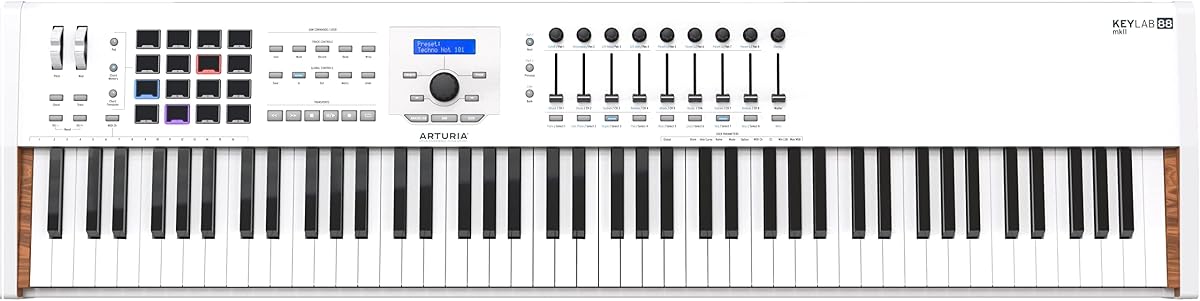
The Arturia KeyLab 88 MkII is renowned for its high-quality Fatar TP/100LR keybed, offering a realistic piano feel. It includes aftertouch and a full suite of controls like 9 faders and 9 knobs. This model is a powerhouse for users who demand premium build quality and expressive capabilities.
We may earn a commission when you buy through this link, at no additional cost to you.
Its standout feature is the keybed, which is highly regarded for its accuracy and durability. The controller comes with Analog Lab V software, providing access to a wide array of synthesizers. The control surface is extensive, allowing for deep interaction with your DAW and plugins.
The main cons are its weight and price. It is a heavy unit that is not easily portable, and the cost reflects its premium positioning. For some users, the number of controls might be overwhelming. It requires a sturdy stand and a dedicated space in your studio.
This is the best choice for professional producers and pianists who need a high-end controller for a fixed studio setup. If you value realistic touch and comprehensive control, it justifies the investment. It is a solid long-term asset for serious music production.
The Fatar TP/100LR keybed is widely considered one of the best in its class for expressive performance.
With 16 pads and 9 faders, you have every tool needed to manage complex mixes and performances.
We may earn a commission when you buy through this link, at no additional cost to you.
The Arturia KeyLab 88 mk3 in black represents a modern take on the classic studio controller. It features fully weighted hammer-action keys and 12 pressure-sensitive pads. The design is sleek, and it includes a sheet music stand, making it versatile for various playing styles.
We may earn a commission when you buy through this link, at no additional cost to you.
Its strength lies in its balanced feature set and modern connectivity. USB-C power simplifies cabling, and the full-weighted keys offer great expression. The pressure-sensitive pads add a tactile layer to drum programming. It looks stylish and professional on any desk.
It is quite expensive and heavy, which limits its portability. The lack of deep DAW specific mapping compared to competitors might be a drawback for some. However, for users who want a high-quality, standalone instrument feel with studio controls, it delivers well.
This model is recommended for pianists who also need MIDI control and want a stylish, premium build. It fits well in a high-end home studio. The inclusion of a music stand makes it practical for composers working with scores.
USB-C power reduces cable clutter and allows for simpler connections to modern computers and interfaces.
Pressure-sensitive performance pads give you detailed control over drum triggers and sample launching.
We may earn a commission when you buy through this link, at no additional cost to you.
The white version of the Arturia KeyLab 88 mk3 offers the same high-performance features as the black model but with a distinct aesthetic appeal. It features fully weighted hammer-action keys and 12 pressure-sensitive pads. This model brings a fresh look to the studio setup.
We may earn a commission when you buy through this link, at no additional cost to you.
It shares all the functional benefits of the black version, including USB-C power and a sheet music stand. The fully weighted keys provide an authentic piano experience, while the pads add versatility for beat-making. It is a solid choice for those who prioritize style.
The cons are similar to the black version, including its high price and weight. The rating is slightly lower, which may reflect specific user experiences. However, for a high-end studio instrument, it remains a strong performer. The color is unique in the market.
This is ideal for producers and studios where aesthetics matter and a cohesive look is desired. It is suitable for any serious music creation task. The combination of form and function makes it a standout in the premium segment.
The white finish offers a clean, modern look that stands out in traditional black-dominated studio environments.
All technical features match the black model, ensuring you do not sacrifice performance for style.
We may earn a commission when you buy through this link, at no additional cost to you.
The Studiologic SL88 MK2 is a highly regarded controller known for its reliable action and compact design. It features 88 weighted keys and an onboard display for easy navigation. It is often chosen by professionals who need a robust tool for live performance.
We may earn a commission when you buy through this link, at no additional cost to you.
Its key strength is the balance between portability and performance. The keys are weighted but lighter than many competitors, which helps during long sets. The display and encoders allow you to control parameters efficiently without clutter. It is Numa Player compatible, offering great versatility.
It does not have the extensive DAW mapping of some other models, which might be a drawback for home studio users. The software ecosystem is more niche. However, for live gigging, it is a reliable workhorse. The build is durable and built to withstand travel.
This controller is best for musicians who perform live and need a dependable 88-key controller. It offers a practical mix of features for controlling external gear and software. If you prioritize reliability and a streamlined interface, it is a top pick.
Designed for stability and quick access to settings, making it ideal for touring musicians.
Despite having 88 keys, it is designed to take up minimal space on a crowded stage.
We may earn a commission when you buy through this link, at no additional cost to you.
The YAMAHA P71 is an Amazon-exclusive digital piano that doubles as a weighted MIDI controller. It features touch-sensitive keys that replicate an acoustic piano experience. With 10 unique voices, it offers great sound quality for practice and performance.
We may earn a commission when you buy through this link, at no additional cost to you.
Its strength is the sound quality and the weighted action, which is praised for its authenticity. The Dual Mode allows you to layer sounds for a richer effect. It comes with a sustain pedal and power supply, making it a complete package. The user rating is exceptionally high.
It lacks the control surface of a dedicated MIDI controller, such as faders and knobs. It is primarily a piano instrument. For users who need extensive MIDI control over a DAW, it may be limiting. However, it excels as a standalone instrument.
This is perfect for pianists who also need to record MIDI but prioritize sound quality and key feel. It is an excellent home piano option that connects to your computer. If you want a great piano feel without complex controls, it is highly recommended.
Yamaha's acoustic piano technology ensures rich tones and deep bass for a realistic performance.
Dual Mode lets you blend two voices, such as piano and strings, for inspiring new textures.
We may earn a commission when you buy through this link, at no additional cost to you.
The Roland A-88MKII is a high-end controller featuring the PHA-4 keyboard with wood and premium materials. It is built to last and offers unmatched playability for professionals. It includes customizable zones, a shallow depth design, and MIDI 2.0 readiness.
We may earn a commission when you buy through this link, at no additional cost to you.
Its key advantage is the build quality and keybed, which is widely considered one of the best in the industry. The customization features allow you to split the keyboard into zones. The bus power and USB-C connectivity make setup flexible. It is a future-proof option.
The main drawback is the high price, which places it out of reach for many. It is also quite heavy and bulky. For users who do not need MIDI 2.0 or top-tier key action, it may be overkill. However, for pros, it is unmatched.
This is the best choice for professionals who need the best possible action and durability. If budget is not a constraint and you want the premium experience, this is the ultimate tool. It is built for high-demand studio and stage environments.
Built with wood and high-quality components, this controller is designed for long-term dependability.
MIDI 2.0 readiness ensures compatibility with upcoming standards for advanced control.
We may earn a commission when you buy through this link, at no additional cost to you.
Selecting the right 88 key weighted MIDI controller requires evaluating several critical factors. This section breaks down the most important aspects to consider before making your purchase.
The most critical factor is the key action, which determines how the keys feel when you press them. There are semi-weighted, fully weighted, and hammer-action options. Semi-weighted keys are lighter and faster, ideal for synth players. Fully weighted hammer action mimics the feel of an acoustic piano and is preferred by pianists.
Choose hammer action if you need realistic dynamics. Choose semi-weighted if you prioritize speed and electronic genres.
Integration with your digital audio workstation can save you hours of setup time. Some controllers offer one-to-one mapping for software like Ableton Live or Logic Pro. Others require manual configuration or generic MIDI protocols that might not expose every parameter you need.
Look for controllers with built-in scripts for your specific DAW. This ensures all knobs and faders control the right parameters immediately.
Modern controllers offer various connectivity options including USB, MIDI 5-pin, and sometimes Bluetooth. USB-C is becoming standard for power and data. MIDI 5-pin is crucial for connecting to external hardware synths without going through a computer.
Ensure the controller supports the connections you need. If you plan to connect hardware, verify MIDI output ports are present.
Beyond keys, control surfaces like pads, faders, and knobs allow you to manage your music without touching the mouse. Drum pads are great for beat production, while faders are essential for mixing. The number and quality of these controls vary significantly by model.
Prioritize controllers with enough knobs and pads for your workflow. RGB lighting can help identify functions quickly during a live session.
Many controllers come with bundled software like DAWs and instrument plugins. These can save you significant money and help you start making music right away. Check if the software licenses are permanent or require a subscription.
If you are new to production, a bundle with a full DAW and instruments is highly valuable. For pros, this matters less.
An 88-key controller is large and heavy. If you plan to move it between a home studio and a stage, consider the weight and dimensions. Some models have a shallow depth to fit on desk stands.
Check the weight and dimensions before buying. If transport is frequent, look for lighter models or a sturdy case.
Durability is key for any piece of equipment. High-end models use wood and metal to ensure longevity. Cheaper models might use plastic which can crack under stress. A well-built controller will last for years.
Invest in a sturdy chassis if you plan to use it heavily. Metal and wood components generally indicate a longer lifespan.
Aftertouch allows you to add expression after pressing a key, such as vibrato or filter sweeps. Some controllers have channel aftertouch while others have polyphonic aftertouch. This feature is essential for expressive sound design.
Ensure the controller supports the type of aftertouch your software needs. Polyphonic aftertouch is more advanced and useful for complex patches.
To use your controller effectively, first connect it to your computer via USB or MIDI interface. Most modern controllers are plug-and-play and do not require drivers. Ensure your DAW is set to receive MIDI input from the correct device in the preferences menu.
Install any provided software and map the controls to your workflow. For example, assign knobs to filter cutoffs and faders to volume. Using presets can save you time. Regularly update the firmware via the manufacturer's website to keep performance optimal.
For care, keep the keyboard covered when not in use to prevent dust buildup. Clean the keys gently with a soft, dry cloth. Avoid placing heavy objects on the keys and ensure the controller is not subjected to extreme temperatures or humidity during storage.
Semi-weighted keys have a spring mechanism that makes them lighter and faster to press, ideal for synth players. Fully weighted keys use a hammer action mechanism that mimics the resistance of an acoustic piano, offering better dynamics for classical playing.
Many models come bundled with software such as Ableton Live Lite, MPC Beats, or instrument plugins. Always check the specific product page to see what software is included before purchasing.
Aftertouch allows you to add expression like vibrato or volume changes after you press a key. It is essential for expressive performances and dynamic sound design in your recordings.
Yes, many controllers support iOS devices via a USB to Camera Adapter. However, ensure the controller is bus-powered or has a separate power source since the iPad might not provide enough power for larger units.
MIDI 2.0 offers higher resolution and richer data than the classic standard. While it is the future, many current devices still use MIDI 1.0. If you buy a controller with MIDI 2.0 readiness, it will be future-proof for advanced control.
Most 88 key controllers do not come with a stand. It is important to buy a sturdy X or Z-style stand that can support the weight of the controller to prevent it from falling or damaging the desk.
Check if the keys are dirty by using compressed air to clean under them. Ensure your DAW is not muted and that the MIDI channel is correct. Updating firmware or resetting controller settings can also resolve hardware glitches.
Yes, all models listed are compatible with both Windows and macOS. They use standard USB protocols that work across operating systems. Some drivers may need installation, but plug-and-play is common.
Choosing the right 88 key weighted MIDI controller depends on your specific needs as a producer or musician. Our top picks like the Novation Launchkey 88 MK3 and M-AUDIO Keystation 88 MK3 offer great value and workflow enhancements for different users.
Prioritize key action and DAW integration based on your style. If you play piano, a hammer action like the Arturia KeyLab 88 MkII is essential. If you produce beats, control surfaces on the Launchkey 88 are more beneficial.
Remember to check current prices and software bundles as they change frequently. Investing in a quality controller now will pay off in your music production journey. Choose a model that fits your budget and technical requirements for the best experience.