
Askar 71F Flat-Field Telescope, 71mm Aperture F6.9 ED Glass Refractor OTA
4.9Editor score
Quadruplet air-spaced APO
Integrated flat-field design
Lightweight and portable
This guide compares the top ten apochromatic refractors for astronomy, detailing optics, portability, and imaging performance to help you choose the perfect
Apochromatic refractors are the gold standard for astronomers seeking crisp, color-free views. These telescopes use special glass to eliminate chromatic aberration, revealing stunning detail in stars and galaxies.
We evaluated ten top-rated models based on optical quality, build, and value. Our list covers diverse options from compact travel scopes to larger imaging beasts, ensuring a fit for every enthusiast.
Each pick highlights key features, pros, and cons to guide your decision. Please note that product availability and pricing fluctuate frequently, so check current listings before purchasing your ideal scope.
4.9Editor score

4.5Editor score

The following table provides a side-by-side comparison of all ten apochromatic refractors reviewed in this guide. Use it to quickly compare aperture, focal ratio, weight, and special features across different models.




The SVBONY SV550 AP0 is a standout choice for serious astronomers. It features a robust triplet apochromatic design that delivers bright, high-contrast images ideal for viewing galaxies and nebulae.
We may earn a commission when you buy through this link, at no additional cost to you.
Its air-spaced triple optical design virtually eliminates chromatic aberration. This ensures sharp details across the entire field of view, making it a favorite for both visual observation and deep-sky imaging.
While the lack of a mount requires extra planning, the included magnesium alloy focus mount reduces weight significantly. This makes transporting the telescope easier and reduces strain on your mount.
If you seek exceptional optical performance in an 80mm package, this OTA is a top recommendation. It balances price and performance perfectly for those ready to upgrade their setup.
The use of S-FPL51 low-dispersion ED glass effectively improves the blue-edge chromatic aberration problem common in single-ED structures.
A dual-speed toothed focus mount with 1:10 gearing provides the precision needed for critical focus during long-exposure astrophotography sessions.
We may earn a commission when you buy through this link, at no additional cost to you.
The Explore Scientific ED80 Essential Series is renowned for its brilliant, high-contrast views. It uses genuine FCD1 HOYA extra-low dispersion glass to produce excellent views filled with stunning details.
We may earn a commission when you buy through this link, at no additional cost to you.
Its air-spaced triplet optical design virtually eliminates chromatic aberrations, making it great for capturing amazing images of the Moon, planets, and deep sky treats like nebulae.
While the focal length is compact at 480mm, the weight is manageable for its class. The collimation system allows for precise adjustments to get the tightest stars possible.
This scope is ideal if you value brand reputation and USA-based support. It is a reliable workhorse for both spontaneous stargazing and guided imaging sessions.
The combination of genuine FCD1 HOYA ED glass and proprietary enhanced multi-layer coatings on all optical surfaces ensures minimal light loss.
With its retractable dew shield and compact size, it is perfect for mounting atop a larger telescope for guiding or as a standalone travel scope.
We may earn a commission when you buy through this link, at no additional cost to you.
This bundle combines the SVBONY SV550 APO with the SV209 field flattener for a seamless imaging setup. It corrects the field perfectly, supporting both half-frame and full-frame cameras effectively.
We may earn a commission when you buy through this link, at no additional cost to you.
The magnesium alloy material of the focusing seat reduces weight by more than 20% compared to aluminum alloy. This reduces load and makes the telescope easy to carry for field trips.
The package includes an M63 extension tube and M48 adapter ring. These ensure the back focal length of the flat field mirror meets the conventional 55mm length for precise alignment.
For deep sky astrophotographers wanting a ready-to-go solution, this bundle is a top choice. It simplifies the setup process and ensures sharp images across the entire sensor.
The effective field of view of the 45mm large target surface supports not only half-frame cameras but also full-frame cameras seamlessly.
The 180mm dovetail plate features a hollow design that is easy to operate and allows for a diverse choice of accessories.
We may earn a commission when you buy through this link, at no additional cost to you.
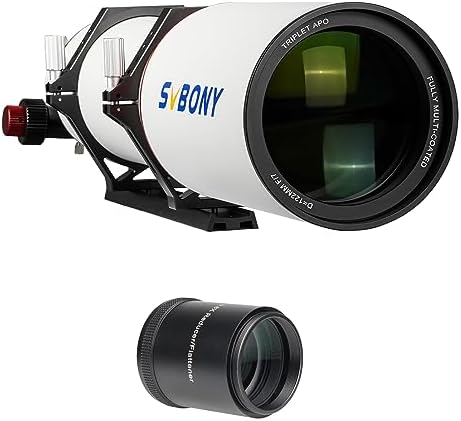
This kit features the SVBONY SV550 APO refractor with a massive 122mm aperture. It gathers more light and offers clear images suitable for deep sky photography and even fainter objects.
We may earn a commission when you buy through this link, at no additional cost to you.
The FPL-51 triplet apochromatic lens structure contains one piece of ED glass. This triplet lens provides better correction of aberration and greatly reduces chromatic aberration and enhances sharpness.
The SV211 dovetail base includes a comfortable and convenient carrying handle. This makes carrying the large-aperture telescope easier and safer after combined installation on your mount.
Ideal for enthusiasts wanting a complete imaging package, this bundle includes essential accessories. It saves time on sourcing parts and ensures all components work well together.
The 122mm aperture offers a higher limiting magnitude, allowing you to see deeper into the cosmos compared to smaller 80mm or 100mm scopes.
The SV211 finder scope mount bracket comes with all necessary screws and wrenches, making it easy to install and remove for transport.
We may earn a commission when you buy through this link, at no additional cost to you.
The Askar 71F takes practicality and versatility into full consideration. It is designed as an affordable and high-quality versatile self-flattened OTA for beginners and travelers.
We may earn a commission when you buy through this link, at no additional cost to you.
Its weight and size are effectively controlled, with an overall weight of 3kg including the hoop and dovetail plate. This makes it easy to carry and use for any astronomy session.
The entire lens barrel uses high-quality CNC processing technology. This reduces stray light reflection and ensures high-quality images whether you are watching birds or deep sky objects.
If you want a scope for both visual observation and photography without breaking the bank, this is a fantastic choice. It offers flat-field performance at a budget-friendly price.
You can use it for both visual observation and photography, or even for watching birds and scenery during the day.
The built-in flat-field design means you do not need to buy a separate field flattener, saving you money and complexity.
We may earn a commission when you buy through this link, at no additional cost to you.
The SVBONY SV503 features a 102mm aperture with FMC coating to improve light transmission. This delivers brighter, higher-contrast images for both astrophotography and visual observation.
We may earn a commission when you buy through this link, at no additional cost to you.
Its S-FPL51 ED glass significantly minimizes color fringing. This ensures true-to-life color and sharp detail, making it perfect for planetary observation and deep-sky astrophotography.
The built-in 360-degree field rotator allows perfect camera alignment without tube rotation. Coupled with the smooth dual-speed focuser, achieving and maintaining critical focus is effortless.
If you prioritize a larger aperture for detailed visual views or want solid astrophotography basics, this is a strong contender. The retractable hood actively blocks stray light and prevents dew.
With 90mm of focus travel, this refractor enables precise focusing even when used with astrophotography accessories such as filter wheels and field flatteners.
The 360-degree field rotator simplifies camera framing and allows you to rotate the field without moving the entire telescope tube.
We may earn a commission when you buy through this link, at no additional cost to you.
This bundle is designed specifically for prime focus astrophotography with the SV550 122mm f/7 apo refractor. It includes the SV209 field flattener and 0.8X focal reducer for optimal results.
We may earn a commission when you buy through this link, at no additional cost to you.
The SV209 field flattener corrects the defect of field curvature of the user's shooting target. This improves the imaging quality and shooting efficiency of the edge of the field of view.
The FPL-51 triplet apochromatic lens structure enhances clarity and sharpness. This makes it suitable for deep sky photography and observation, and even some fainter deep sky objects.
For those aiming for wide-field images with a large aperture, this kit is perfect. It simplifies the setup process and provides the tools needed for high-quality deep sky imaging.
The SV209 field flattener specifically corrects field curvature, ensuring stars remain round across the entire frame.
The 0.8X focal reducer reduces the focal ratio, allowing for a wider field of view and faster exposures on deep sky objects.
We may earn a commission when you buy through this link, at no additional cost to you.
This kit offers a complete solution for astrophotography enthusiasts. It includes the SV550 APO refractor with a 122mm aperture and the SV209 field flattener with focal reducer.
We may earn a commission when you buy through this link, at no additional cost to you.
The SV209 0.8X focal reducer field flattener is designed specifically for prime focus astrophotography. It helps correct defects in field curvature to improve shooting efficiency.
The SV211 dovetail base features a portable handle for comfortable and convenient carrying. After installation, the large-aperture telescope can be easily carried and moved.
For users ready to invest in a full imaging system, this kit saves time. It provides all necessary components for field correction and light gathering in one package.
The 122mm aperture gathers more light, offering clearer images suitable for fainter deep sky objects compared to smaller scopes.
The portable handle on the dovetail base makes moving the telescope significantly easier, which is vital for travel setups.
We may earn a commission when you buy through this link, at no additional cost to you.
This kit uses the SV550 80 F6 OTA with an SV209 field flattener. It effectively improves the image quality problem of fringe field curvature common in standard setups.
We may earn a commission when you buy through this link, at no additional cost to you.
The optics are sharp and ultra wide band fully multilayer coated. Double glass and 30mm achromatic optics prevent irritating reflections to bring you bright and clear images.
The SV209 flattener is designed specifically for the SV550 80F6 OTA. This ensures compatibility and optimal field correction for deep sky targets like M42 and M45.
If you prefer a lighter setup that still offers triplet performance, this is an ideal choice. It simplifies astrophotography by including the necessary flattener in the package.
The fully multilayer coated lens ensures maximum light transmission and minimum internal reflections for sharp views.
The convenient carrying handle allows you to adjust its position to improve the safety factor of the product installation process.
We may earn a commission when you buy through this link, at no additional cost to you.
This bundle includes the SV550 APO refractor, a mini guide scope, and a telescope camera. The SV905C camera is highly sensitive and perfect for autoguiding or planetary imaging.
We may earn a commission when you buy through this link, at no additional cost to you.
The camera has small 3.75-micron pixels and a high peak QE of 80%. This low read noise allows tight tracking of faint guide stars for precise long-exposure imaging.
The SV165 Mini Guide Scope is compact and highly sensitive. It works seamlessly with the SV905C camera to provide the guiding stability needed for deep sky photography.
For beginners or those wanting a ready-to-go guiding setup, this kit is invaluable. It provides all the essential components to start tracking the stars accurately.
The combination of the SV905C camera and SV165 guide scope ensures that tracking errors are corrected quickly and accurately.
With the guide system handled, you can focus on using the 122mm aperture to capture detailed deep sky images with your main camera.
We may earn a commission when you buy through this link, at no additional cost to you.
Choosing the right apochromatic refractor involves balancing optical quality, portability, and budget. Consider these factors to find the perfect scope for your astronomy goals.
Aperture determines how much light the telescope can gather. Larger apertures like 100mm or 120mm provide brighter images and resolve finer details, while smaller 70mm to 80mm scopes offer portability.
Choose an aperture that matches your observing needs and transport capabilities.
The focal ratio (f-number) affects the field of view and exposure times. Shorter ratios like f/6 are faster for deep sky imaging, while longer ratios like f/7 or f/8 offer higher magnification for planets.
Select a focal ratio that aligns with your primary targets in the night sky.
High-quality ED glass like S-FPL51 or FCD1 minimizes chromatic aberration and ensures sharp, color-free images. This is critical for true apochromatic performance.
Always look for scopes that specify low-dispersion ED glass for best results.
A lightweight design is essential for traveling to dark sky sites. Look for features like magnesium alloy parts and compact cases to reduce the burden of carrying your equipment.
Prioritize portability if you plan to set up frequently or travel often.
A smooth, dual-speed focuser allows for precise adjustments required in astrophotography. It helps you achieve critical focus without shaking the setup during long exposures.
Ensure the focuser has enough travel and stability for your cameras.
Bundles that include field flatteners, focal reducers, or guides simplify the setup process. These accessories are crucial for correcting field curvature and improving image quality.
Check if the bundle includes essential accessories to save money and time.
Allow your telescope to acclimatize to the outside temperature before observing. This reduces air currents inside the tube that can blur your images.
Clean the optical surfaces only when necessary using a soft brush and air blower. Avoid touching the lenses with fingers to prevent oils from damaging the coatings.
Store your telescope in a dry, cool place and cover it with a dust cap when not in use. Regular maintenance ensures the longevity of your precision optical instruments.
An apochromatic refractor is a telescope that uses special low-dispersion glass to minimize chromatic aberration. This allows for sharp, color-free images of stars and planets.
Yes, they are excellent for astrophotography due to their crisp optics. They eliminate color fringing and provide flat fields when paired with the correct accessories.
A 70mm to 80mm aperture is ideal for beginners. It offers a good balance of light-gathering power and portability for both visual observation and imaging.
Yes, a sturdy mount is essential for holding the telescope steady. Without a good mount, long-exposure photography and detailed viewing will be impossible.
ED lenses are made of low-dispersion glass that reduces color fringing significantly. This ensures that stars appear white and sharp rather than having colored halos.
Use a soft brush or air blower to remove dust gently. Only use a microfiber cloth for stubborn marks to avoid scratching the delicate coatings.
The SVBONY SV550 AP0 stands out as our top pick for its exceptional color correction and robust design. It is perfect for those seeking professional-level performance.
The Askar 71F offers incredible value for budget-conscious users wanting a compact imaging solution. It balances performance and price effectively for beginners.
Remember that prices change frequently, so check current listings before purchasing. With the right choice, you will be ready to explore the wonders of the night sky.