
ADS1115 16 Bit I2C Module
5.0Editor score
Sixteen bit resolution precision
Four channel input support
Wide voltage supply range
This guide compares the top ten Arduino ADC boards for precision measurement, data acquisition, and sensor integration across various project needs and budgets.
Choosing the right analog to digital converter board is essential for any maker working with sensors on Arduino platforms. These modules bridge the gap between analog signals and digital processing, allowing precise measurements of voltage, temperature, and more.
We evaluated ten highly rated ADC boards based on resolution, channel count, communication interfaces, and compatibility with popular microcontrollers. Each selection offers unique strengths for different applications ranging from simple hobby projects to industrial data logging systems.
Every pick highlights key specifications and real world performance traits to help you match a module to your specific requirements. Keep in mind that pricing and availability fluctuate frequently so always verify current details before finalizing your purchase decision.
5.0Editor score

4.6Editor score

4.4Editor score
The following table provides a side by side overview of all ten selected ADC boards comparing their core specifications resolution channel configurations and interface types to streamline your selection process.




This three pack of ADS1115 modules offers excellent value for makers needing multiple ADC units. With a 4.7 rating it stands out for reliability and precision in converting analog signals to digital data effectively.
We may earn a commission when you buy through this link, at no additional cost to you.
The sixteen bit resolution allows capturing minute voltage changes down to 7.8 microvolts making it ideal for sensitive sensors like thermocouples or strain gauges. Its programmable gain amplifier lets you adjust input ranges to optimize accuracy.
While the I2C interface simplifies wiring it does require adding a library to your code. The small pin spacing can also be tricky for beginners using standard breadboards without jumper wires or headers.
Overall this is the top recommendation for general projects requiring precision analog input. It balances performance affordability and ease of use better than most competitors in this category.
The ADS1115 chip delivers true sixteen bit resolution enabling detection of tiny voltage fluctuations that lower resolution ADCs would miss.
Programmable gain settings allow you to measure signals from 0.256 volts up to 6.144 volts ensuring optimal sensitivity for different sensors.
We may earn a commission when you buy through this link, at no additional cost to you.
The ADS1256 module pushes resolution limits with its twenty four bit ADC chip making it a powerful choice for demanding measurement tasks. It earns a 4.6 rating for consistent performance in data acquisition scenarios.
We may earn a commission when you buy through this link, at no additional cost to you.
Eight channels allow simultaneous monitoring of multiple signals while the internal 2.5V reference ensures stability. The low nonlinearity of 0.0010 percent means readings stay accurate even across wide input ranges.
SPI communication is faster than I2C but requires more wiring and code setup. The higher cost compared to standard ADS1115 boards is justified only when you truly need this level of precision.
Choose this board for professional or industrial projects where measurement accuracy is critical. It outperforms consumer grade options in stability and noise rejection.
Designed for professional applications the ADS1256 offers nonlinearity specs rarely seen in hobbyist modules ensuring trustworthy data for critical systems.
Eight input channels enable comprehensive system monitoring without needing multiple separate modules simplifying complex wiring setups.
We may earn a commission when you buy through this link, at no additional cost to you.
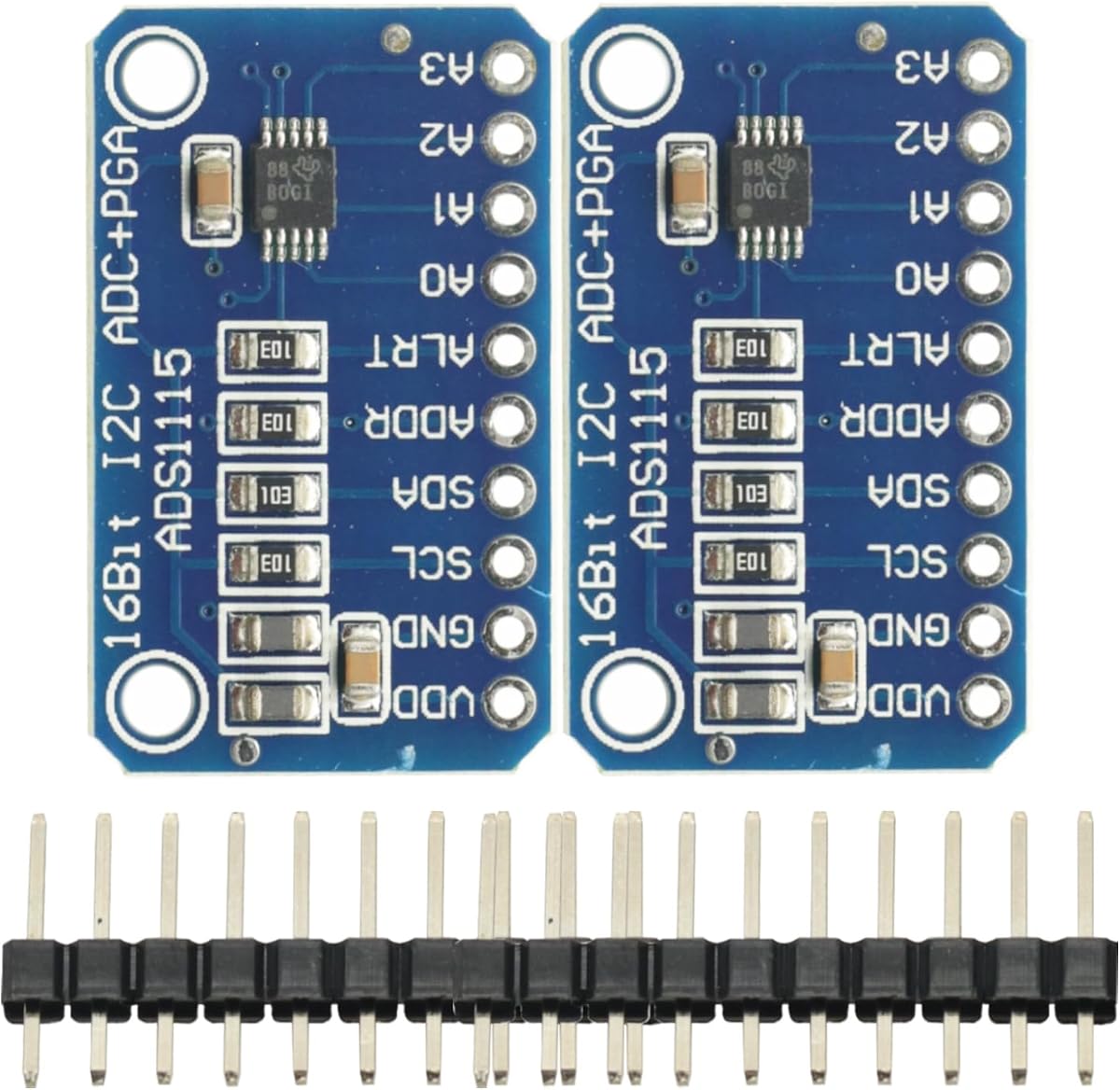
With a perfect 5.0 rating this two pack represents the best value option for entry level ADC needs. It delivers the core ADS1115 performance without extra cost or frills.
We may earn a commission when you buy through this link, at no additional cost to you.
The wide input voltage range of 2.0 to 5.5 volts ensures compatibility with both 3.3V and 5V logic systems. Programmable gain settings let you tweak sensitivity for different sensor types easily.
The module lacks pre soldered headers which might require some soldering for permanent installs. However the low price makes it easy to buy extras for experimentation without financial risk.
If you need reliable ADCs on a tight budget this is the clear winner. It meets all essential specs for typical Arduino and Raspberry Pi projects.
At this price point you get two fully functional sixteen bit ADC modules perfect for students or hobbyists testing multiple sensor types.
Seven programmable input ranges allow you to optimize resolution for small signal sensors or use wider ranges for general purpose measurements.
We may earn a commission when you buy through this link, at no additional cost to you.
This three pack offers a balanced mix of quantity and performance with a 4.3 rating. It includes useful features like comparator mode for threshold detection without CPU intervention.
We may earn a commission when you buy through this link, at no additional cost to you.
The single shot mode auto shuts down to save power when not actively converting. This makes it suitable for battery powered projects where efficiency matters alongside accuracy.
Some users report slightly lower quality control compared to premium brands but it functions reliably for most applications. The inclusion of three units provides great stock for multi sensor projects.
Ideal for classroom labs or prototyping where you need multiple boards without high costs. The comparator feature adds functionality often missing in basic modules.
Auto shut down in single shot mode minimizes power draw extending battery life for portable sensor nodes significantly.
Onboard comparator allows triggering interrupts based on voltage thresholds freeing up microcontroller resources for other tasks.
We may earn a commission when you buy through this link, at no additional cost to you.
Buying four units at once reduces the per module cost significantly. With a 4.1 rating this option prioritizes volume over premium build quality.
We may earn a commission when you buy through this link, at no additional cost to you.
The internal oscillator removes the need for external timing components simplifying the design. All core ADS1115 features including PGA and differential inputs are present here.
Quality control can be inconsistent with bulk packs so testing each unit upon arrival is recommended. It remains a practical choice for large scale deployments.
For projects requiring many ADC points like environmental monitoring arrays this bulk pack delivers the quantity needed at an attractive price point.
Purchasing in bulk dramatically lowers the cost per channel making large sensor arrays financially viable for constrained budgets.
Built in oscillator removes external crystal requirements reducing component count and assembly time for each module.
We may earn a commission when you buy through this link, at no additional cost to you.
This two pack matches the perfect rating of other budget options with a 5.0 score. It provides reliable ADS1115 functionality for standard sensor readouts.
We may earn a commission when you buy through this link, at no additional cost to you.
The standard I2C interface ensures it works seamlessly with Arduino and Raspberry Pi without additional logic levels. Voltage compatibility from 2.0 to 5.5 volts covers most project needs.
It lacks unique features but that also means fewer points of failure. It is a safe choice for those wanting proven performance without experimentation risks.
Recommended for standard applications where two channels are sufficient. The perfect rating suggests consistent quality control from this vendor.
A perfect five star rating indicates consistent manufacturing quality reducing the risk of defective units upon arrival.
Operation between 2.0 and 5.5 volts ensures compatibility with diverse logic levels found in modern development boards.
We may earn a commission when you buy through this link, at no additional cost to you.
This premium offering stands out with ENIG plating for superior solderability and corrosion resistance. A 4.4 rating reflects strong build quality and attention to detail.
We may earn a commission when you buy through this link, at no additional cost to you.
Pre soldered headers save time and effort while open source library support simplifies coding for ESP32 and C++ users. The brand focuses on educational and maker communities.
The higher cost compared to generic modules is justified by durability and developer support. It is a smart investment for projects requiring longevity.
Choose this if you value build quality and community resources. It bridges the gap between hobbyist and professional grade components effectively.
ENIG gold plating protects against oxidation ensuring reliable connections even in humid or challenging environments.
Open source libraries and clear documentation reduce development time for both beginners and experienced engineers.
We may earn a commission when you buy through this link, at no additional cost to you.
This module targets high speed data capture with a 200KHz sampling rate across eight channels simultaneously. It is ideal for audio or vibration analysis.
We may earn a commission when you buy through this link, at no additional cost to you.
Synchronous sampling ensures all channels are sampled at the exact same time critical for phase sensitive measurements. The input range supports both 5V and 10V signals.
A low 3.0 rating suggests potential reliability or compatibility issues reported by users. Integration requires specific SPI handling that may challenge beginners.
Use only for specialized high speed tasks where timing precision is paramount. Verify community support before committing to this niche module.
Simultaneous channel sampling eliminates timing skew ensuring accurate correlation between multiple sensor readings in real time.
Two hundred kilohertz sampling allows capturing rapid signal changes that standard ADC modules would smooth over or miss entirely.
We may earn a commission when you buy through this link, at no additional cost to you.
This four pack combines quantity with a strong 4.6 rating suggesting reliable quality control. It offers standard ADS1115 performance for a good bulk price.
We may earn a commission when you buy through this link, at no additional cost to you.
Readings are described as stable and accurate making it suitable for monitoring projects that run for long periods. Wide compatibility ensures it works across platforms.
Lacking unique features it relies on proven specs for success. The high rating indicates user satisfaction with performance and value delivered.
Best for large IoT deployments or multi sensor systems. It balances cost and performance well for extended monitoring tasks.
Users report consistent readings over time making it suitable for environmental monitoring systems that operate continuously.
Works seamlessly with Arduino Raspberry Pi and other popular microcontrollers without requiring special hardware adapters.
We may earn a commission when you buy through this link, at no additional cost to you.
For those needing just one ADC board this single unit offers all essential features at a low cost. It scores a 4.3 rating for consistent functionality.
We may earn a commission when you buy through this link, at no additional cost to you.
All standard ADS1115 capabilities including PGA and comparator mode are included. It provides a hassle free way to add analog inputs to projects.
Buying single units allows flexibility when quantities vary across projects though cost per unit is higher than bulk packs.
Choose this for one off projects or prototyping. It is a convenient entry point for adding precision analog measurement to your toolkit.
Purchasing single units allows you to buy only what you need without committing to multi pack bulk quantities.
Fully compatible with existing Arduino libraries and examples ensuring quick setup and reliable operation.
We may earn a commission when you buy through this link, at no additional cost to you.
Selecting the right ADC module depends on your project requirements resolution speed and budget. Consider these factors to narrow down the options.
Resolution determines the smallest voltage change the ADC can detect. Higher bit counts like 24 bit provide finer detail suitable for sensitive sensors while 16 bit covers most hobby applications.
Choose higher resolution when measuring small signals like thermocouples or strain gauges.
More channels allow monitoring multiple sensors with a single module. Most boards offer 4 to 8 inputs but you can stack I2C devices to expand further.
Ensure you have enough channels for your current needs plus room for future expansion.
I2C is simpler and uses fewer pins but SPI offers faster data rates. Choose based on your microcontroller's available pins and speed requirements.
SPI is better for high speed applications while I2C saves pin space on small boards.
A built in gain amplifier lets you adjust input ranges to match sensor outputs. This improves accuracy by optimizing the ADC's full scale range for your specific signal.
Always select a board with PGA when working with low voltage sensors.
Check that the ADC supports your system's logic levels. Most modern boards accept 3.3V and 5V inputs but verifying this prevents damage to your microcontroller.
Ensure the board's operating voltage matches your development board specifications.
Higher sampling rates capture faster changing signals. For audio or vibration analysis look for 100KHz or more while slower sensors need less.
Match sampling rate to the frequency of the signal you plan to measure.
Premium boards feature better plating and soldering which affects durability. Look for lead free and gold plated finishes if the project requires longevity.
Invest in higher build quality for permanent installations or harsh environments.
Good libraries simplify coding by handling low level communication. Check if community libraries exist for your preferred programming language or IDE.
Prefer vendors with active open source communities for better documentation.
Connect the VCC and GND pins to your microcontroller's power supply ensuring voltage compatibility before applying power.
Wire the SDA and SCL pins to your microcontroller's I2C lines or MISO MOSI SCK for SPI connections depending on the module.
Install the appropriate ADC library through your IDE and use provided examples to test readings before integrating into your project code.
I2C boards use two data pins plus power and ground making them easier to wire on tight boards. SPI boards use more pins but transfer data faster which is beneficial for high speed sampling tasks.
Yes you can daisy chain I2C ADC modules by changing their address pins. Most boards support four addresses allowing up to sixteen channels from four boards on a single bus.
Yes most boards require a software library to handle communication protocols like I2C or SPI. Popular libraries exist for Arduino and Python that simplify reading and converting values.
Higher resolution allows detecting smaller voltage changes which is crucial for sensors that produce low amplitude signals. This ensures you don't lose detail when measuring small variations.
A programmable gain amplifier adjusts the signal level before conversion allowing you to match the sensor output to the ADC's input range. This improves accuracy and maximizes resolution.
No ADC boards measure voltage. To measure current you must pass it through a shunt resistor and measure the voltage drop across it then calculate current using Ohm's law.
We reviewed ten options ranging from budget friendly ADS1115 packs to high precision ADS1256 modules. The best choice depends on your specific needs for channel count and speed.
Prioritize resolution and gain options if measuring sensitive sensors. For general use standard I2C boards offer the best balance of cost and performance.
Prices and availability change often so verify current details before purchasing. Check community support and library compatibility to ensure a smooth development experience.