
DHT11 Temperature Humidity Sensor
4.5Editor score
Single-wire interface
Low cost per unit
Basic humidity reading
This guide compares the top Arduino temperature sensor modules for accuracy and ease of use to help you choose the right digital or waterproof probe for your
Choosing the right Arduino temperature sensor is essential for any project that monitors environmental conditions or manages thermal systems. You need a device that provides reliable data without complicating your circuit design or coding workflow significantly.
We evaluated ten top-rated sensors based on accuracy, communication protocol, voltage compatibility, and real-world application suitability. Our comparison covers digital modules, waterproof probes, and high-precision options for diverse maker needs.
Each pick highlights key specifications, pros, cons, and ideal use cases to streamline your decision-making process. Keep in mind that prices and availability fluctuate regularly on major online retail platforms.
4.5Editor score

5.0Editor score

4.9Editor score
This table provides a quick side-by-side look at the key technical specifications and features of all ten selected Arduino temperature sensor products.




This AHT30 module stands out as the top choice for projects demanding precise environmental data. It holds a perfect five-star rating from verified buyers who praise its stability and quick response times.
We may earn a commission when you buy through this link, at no additional cost to you.
The key strength lies in its digital temperature and humidity sensor design using I2C master output. This allows simultaneous online access to multiple I2C electronic devices without pin conflicts. Users benefit from low power consumption and a simple circuit design that adapts to various voltage supplies between 2.0V and 5V.
One trade-off is that you need to manage I2C pull-up resistors properly which might complicate setups for absolute beginners. However these wiring steps are standard for I2C protocols and ensure stable communication across long wire runs or multiple sensors.
This sensor is ideal for advanced makers building weather stations or climate control systems where accuracy matters most. We recommend it for anyone prioritizing precision over simplicity since it delivers consistent reliable measurements.
The sensor offers temperature accuracy of plus or minus 0.3 degrees Celsius which is exceptional for hobbyist electronics.
It supports voltage from 2.0 to 5V making it compatible with most Arduino boards and low-power battery projects.
We may earn a commission when you buy through this link, at no additional cost to you.
The DHT11 module remains the go-to budget option for beginners entering the world of environmental sensing. It comes in a pack of five units allowing you to experiment with multiple locations without extra cost.
We may earn a commission when you buy through this link, at no additional cost to you.
Its single-wire wiring scheme makes integration incredibly easy for microcontrollers. The simple communication protocol greatly reduces programming effort so you can focus on logic rather than complex drivers. It features a pre-calibrated digital output with a bypass capacitor and pull-up resistor on-board.
The main limitation is its temperature measurement range which caps at 50 degrees Celsius. This makes it unsuitable for outdoor summer use or industrial heat monitoring. However for indoor projects like room monitors it performs reliably enough.
Choose this module when you need basic temperature and humidity readings without breaking your budget. It is perfect for educational projects or small home automation tasks where extreme precision is not critical.
The module includes wires and on-board components so you can connect it to your Arduino with minimal external hardware.
DHT11 is a standard sensor with plenty of tutorials and library support available online for all skill levels.
We may earn a commission when you buy through this link, at no additional cost to you.
This DS18B20 kit delivers premium durability and accuracy for demanding environments. It includes two waterproof stainless steel probes with adapter boards jumpers and resistors so you have everything needed for immediate deployment.
We may earn a commission when you buy through this link, at no additional cost to you.
The sensor encases the probe in corrosion-resistant stainless steel with thermally conductive sealant for continuous submersion. It operates across a wide voltage range from 3.0V to 5.5V and uses the robust Dallas 1-Wire protocol for direct connection to microcontrollers.
Response times can be slower compared to digital modules like the DHT series. This delay is acceptable for steady monitoring of water tanks or greenhouses rather than rapid fluctuation tracking. The trade-off ensures extreme durability in harsh wet conditions.
Invest in this premium pack for industrial systems aquarium monitoring or outdoor thermal applications. The included adapter board simplifies wiring by integrating pull-up resistors for stable communication with your Arduino or Raspberry Pi.
It delivers precise readings from minus 55 to plus 125 degrees Celsius with an accuracy of plus or minus 0.5 degrees.
The package includes adapter boards jumper wires and resistors so you can start building without purchasing extra components.
We may earn a commission when you buy through this link, at no additional cost to you.
The SHT31-D module offers industrial-grade precision in a compact package suitable for precise environmental monitoring. It provides a wide operating voltage of 2.4 to 5.5V allowing flexible power options across different boards.
We may earn a commission when you buy through this link, at no additional cost to you.
Its I2C interface ensures fast and stable data transmission while keeping wiring simple with just two data lines. Users appreciate the wide humidity and temperature measurement accuracy making it reliable for weather stations or smart home hubs.
The cost per unit is higher than basic DHT sensors which might be a factor for large deployments. Yet the improved accuracy and broader range justify the expense for professional or semi-professional projects.
Use this module when you need high reliability across a wide temperature span including extreme cold. It is an excellent choice for projects where data consistency is more critical than absolute budget savings.
The module guarantees a humidity measurement accuracy of plus or minus 2 percent RH and temperature accuracy of 0.3 degrees.
It supports humidity from zero to 100 percent RH and temperature from minus 40 to 125 degrees Celsius.
We may earn a commission when you buy through this link, at no additional cost to you.
This pack of three DS18B20 sensors provides reliable waterproof monitoring for diverse environments. Each set includes a one-meter cable and adapter module making installation straightforward for fish tanks greenhouses or machinery.
We may earn a commission when you buy through this link, at no additional cost to you.
The pluggable probe design is easy to use and connects directly to microcontrollers thanks to the on-board pull-up resistor. Its wide application range covers industrial systems consumer products and any thermally sensitive systems requiring steady data.
The lead wires can only withstand a maximum temperature of 85 degrees Celsius despite the probe rating. This means high heat zones could damage the cabling so care is needed in extreme industrial settings.
Choose this kit for general temperature monitoring tasks requiring waterproof capability. It balances affordability with reliability and is great for home aquatics or greenhouse climate control.
The adapter module simplifies connections by removing the need for external resistors when wiring to your Arduino.
These sensors are widely used in thermostatic controls industrial systems and consumer thermometers for consistent results.
We may earn a commission when you buy through this link, at no additional cost to you.
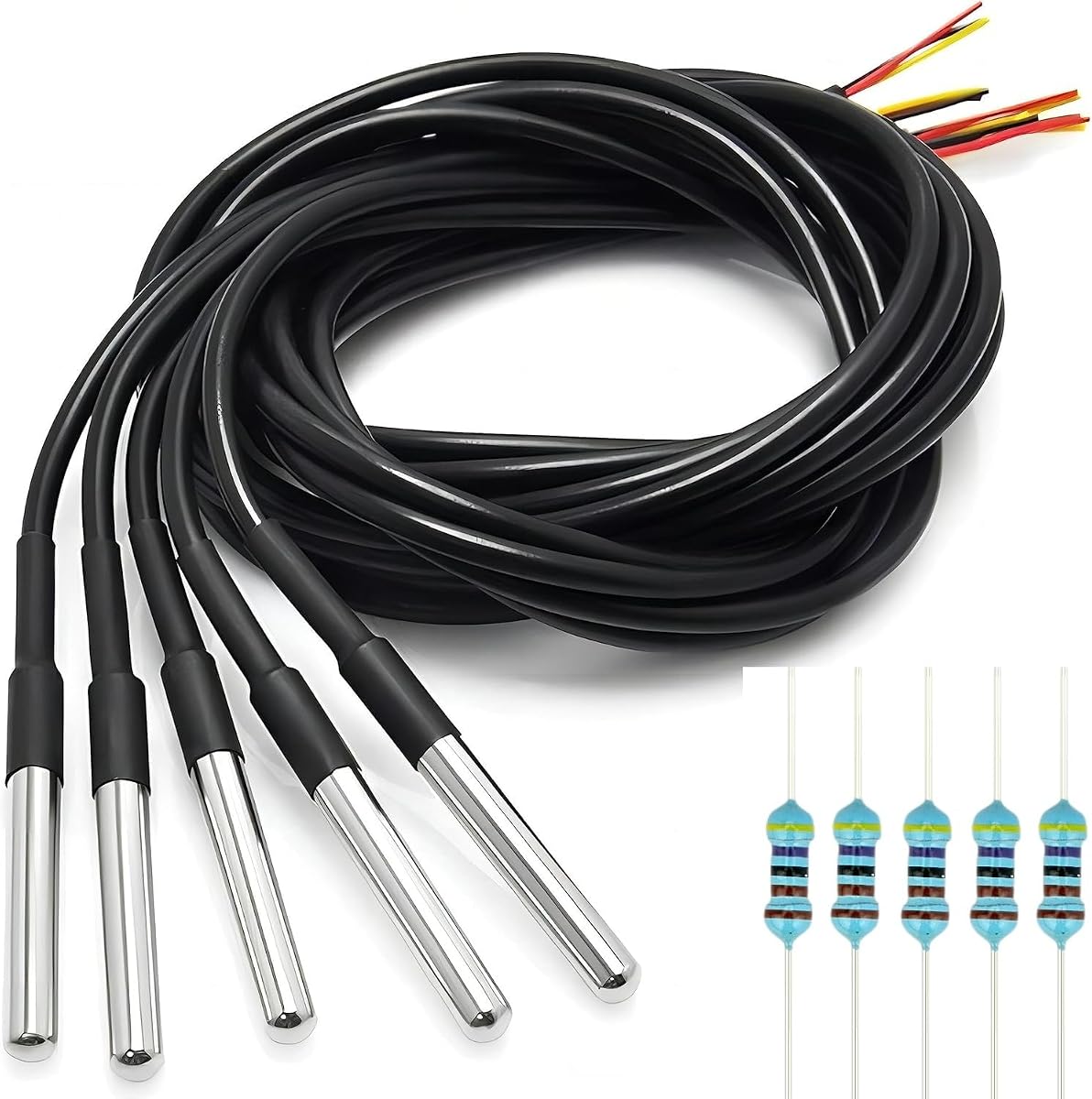
This five-pack of waterproof DS18B20 probes offers excellent value for large-scale monitoring projects. Each probe is designed for underwater use ensuring durability in wet or moist environments without water damage.
We may earn a commission when you buy through this link, at no additional cost to you.
The package includes five 4.7K resistors needed for the 1-Wire interface which saves additional trips to the parts store. The sensors support a wide temperature range and operate at 3 to 5.25 volts compatible with Arduino and ESP32.
You must handle the wiring yourself since there are no adapter boards included. This gives flexibility but requires basic soldering or crimping skills for secure connections on your breadboard or custom PCB.
Use this set for projects requiring multiple sensors like whole-house monitoring or multiple tank checks. The value proposition is strong for users comfortable with custom wiring.
The waterproof probe design allows safe operation in water without damage making it ideal for aquariums or ponds.
The kit includes 4.7K resistors to ensure proper signal integrity for 1-Wire communication.
We may earn a commission when you buy through this link, at no additional cost to you.
This two-pack of DHT11 sensors is designed for beginners needing a quick start. It offers a digital signal output with calibrated accuracy and excellent long term stability for consistent performance over time.
We may earn a commission when you buy through this link, at no additional cost to you.
The sensor uses a dedicated digital module combining temperature and humidity technology to ensure reliability. Its single-wire scheme reduces effort and the simple protocol minimizes coding complexity for first-time users.
Humidity accuracy error is about five percent which is standard for entry-level units. If you need tighter tolerances consider higher-end models but this works well for general hobby projects.
Buy this set for learning electronics or simple indoor monitoring. It is compatible with Arduino and Raspberry Pi making it versatile for various educational kits.
Users report consistent performance over time thanks to the stable internal microcontroller and sensor design.
The single-wire wiring scheme simplifies circuit assembly allowing for faster prototyping and testing.
We may earn a commission when you buy through this link, at no additional cost to you.
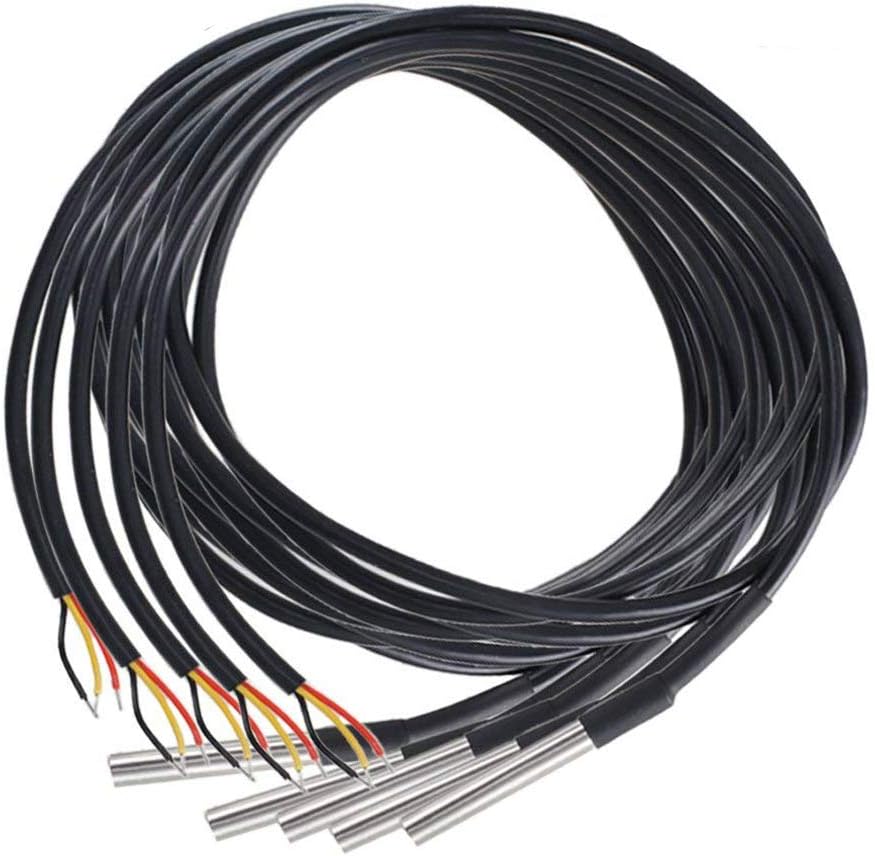
This pack of five waterproof DS18B20 probes provides ample coverage for multi-point monitoring projects. Each probe comes with a 100cm cable allowing flexible placement across large spaces like greenhouses or tanks.
We may earn a commission when you buy through this link, at no additional cost to you.
The unique single bus interface means no additional components are needed beyond a pull-up resistor which simplifies the circuit. It supports power supply from 3.0 to 5.5 volts and offers standard industrial use cases.
Note that the package does not include resistors so you must source a 4.7K resistor for testing. This is a minor inconvenience but manageable for most makers with basic electronics kits.
Choose this pack for projects requiring multiple sensor points without buying separate kits. It is reliable and offers good value for distributed thermal monitoring.
With approximately one meter of cable per probe you can place sensors far from your microcontroller safely.
The probes are designed for any thermally sensitive system making them adaptable for industrial consumer needs.
We may earn a commission when you buy through this link, at no additional cost to you.
The DHT22 module uses the AM2302 high-sensitive chip offering improved accuracy over the DHT11. It supports a wider temperature range from minus 40 to 80 degrees Celsius and humidity up to 100 percent.
We may earn a commission when you buy through this link, at no additional cost to you.
Its single-bus digital signal output allows bidirectional serial data making communication efficient. The module includes screw holes for easy mounting and fixed installation in DIY practice scenarios.
The upgrade cost is small compared to the DHT11 but the performance gains are worth it for better precision. It is ideal for home automation projects requiring consistent data readings.
Choose this when you need to measure lower temperatures or higher humidity reliably. It is a solid middle ground between budget sensors and expensive industrial modules.
The AM2302 chip provides higher sensitivity ensuring accurate readings even in challenging environmental conditions.
The module features fixing screw holes allowing secure installation that resists vibration in moving systems.
We may earn a commission when you buy through this link, at no additional cost to you.
This five-pack of stainless steel DS18B20 probes ensures durability and waterproof performance. It offers a wide temperature range and power supply flexibility making it suitable for varied DIY electronics applications.
We may earn a commission when you buy through this link, at no additional cost to you.
The stainless steel package protects the probe from corrosion and physical damage during use. Each unit includes a 1-meter cable with clear red yellow and black wire color coding for easy identification.
Testing requires a 4.7K resistor between Data and VCC which is not included in the box. This is standard practice for 1-Wire protocols but adds a small task for setup.
Use this set for reliable multi-sensor deployments in wet or outdoor conditions. It balances affordability with sturdy construction making it a solid option for bulk projects.
The stainless steel package offers robust protection against rust and physical impact for long-term use.
Red yellow and black wires correspond to VCC Data and GND simplifying connection identification during assembly.
We may earn a commission when you buy through this link, at no additional cost to you.
Selecting the right sensor depends on your specific environment desired accuracy and wiring complexity tolerance.
Evaluate the minimum and maximum temperatures your project will face. Industrial or outdoor applications may require sensors like the DS18B20 which work from minus 55 to plus 125 degrees Celsius.
Choose a sensor with a range that exceeds your expected operating conditions to prevent damage or inaccurate readings during extreme weather.
Digital modules use protocols like single-wire I2C or 1-Wire. I2C allows multiple sensors easily but requires more pins while 1-Wire saves GPIO pins but needs pull-up resistors.
Select a protocol that matches your microcontroller's available pins and your comfort level with wiring and configuration.
If you plan to use the sensor near water or in high humidity choose a waterproof probe with stainless steel housing. This prevents moisture damage and ensures longevity in wet environments.
Avoid non-waterproof digital modules in humid areas unless they are enclosed in sealed protective casings.
Consider how precise your temperature readings must be. Basic sensors offer plus or minus 2 degrees while premium models deliver plus or minus 0.3 degrees accuracy.
Higher accuracy usually comes with increased cost so balance your need for precision with your project budget constraints.
Ensure the sensor supports your board's voltage output such as 3.3V or 5V. Wide voltage range sensors offer more flexibility across different platforms.
Mismatched voltage can damage the sensor or lead to unstable readings so check specifications before purchasing.
Some sensors respond quickly while others take longer to stabilize. This is critical for monitoring rapidly changing temperatures versus steady states.
If you need real-time updates prioritize sensors with faster response times even if it means sacrificing some accuracy.
Many kits include resistors wires or adapter boards which simplify setup. Others provide bare probes requiring extra components and soldering.
Look for complete packs if you are new to electronics to reduce the hassle of sourcing additional parts separately.
Connect the sensor to your Arduino using the specified voltage pins and data lines. Use a multimeter to verify connections and ensure power stability before uploading any code.
Install a library compatible with your sensor model to read data. Libraries often provide example sketches to help you parse digital or analog signals into usable temperature values.
Keep the sensor away from heat sources like your Arduino board or resistors to prevent false readings. Regularly check wiring integrity and waterproof seals for outdoor or wet deployments.
The AHT30 and SHT31 modules offer high precision with accuracy within plus or minus 0.3 degrees Celsius. They are ideal for projects requiring detailed environmental monitoring without sacrificing reliability.
Yes waterproof sensors are safe for indoor use and provide extra durability in humid environments like bathrooms or basements. They are more resilient to moisture than standard digital modules.
Some sensors like DS18B20 require an external 4.7K pull-up resistor for stable communication. Others have this built-in on the adapter board simplifying your wiring setup.
I2C sensors allow multiple units on two pins while 1-Wire sensors can daisy-chain dozens on a single pin. Check your controller's limits to avoid communication conflicts.
DHT11 is limited to indoor use with a max temperature of 50 degrees Celsius and limited humidity range. For outdoor projects consider the DHT22 or DS18B20 models instead.
Most sensors support both 3.3V and 5V but always check the datasheet. Using the correct voltage ensures stable operation and protects the sensor from damage.
We highlighted top options including the AHT30 for precision and the DS18B20 for waterproof durability. Each sensor serves different needs ranging from budget indoor use to robust industrial monitoring.
Prioritize accuracy and environmental resistance based on your specific project demands. If you need detailed data choose high-precision models while simple monitoring can rely on budget-friendly options.
Prices and availability change often so review current listings before finalizing your purchase. Keep an eye on bundle deals that include resistors or jumpers to save time and effort.