
HiLetgo PCM5102 I2S IIS Lossless Digital Audio DAC Decoder Module
4.2Editor score
Affordable PCM5102A conversion chip
Pre-soldered stereo jack output
Compatible with Arduino and Pi
This guide compares the top ten DAC for Raspberry Pi models offering high-resolution audio outputs software compatibility, and build quality for audiophiles
Choosing the right DAC for Raspberry Pi transforms your single-board computer into a high-fidelity music player. These expansion boards replace the weak internal audio with precise digital-to-analog conversion delivering crisp sound for speakers or headphones.
We evaluated ten popular models based on chip quality, output options, and software support. Each product was tested against common music player systems like Volumio and Moode to ensure seamless integration and reliable performance in real-world setups.
Every pick below highlights specific strengths from budget-friendly options to premium engineering. Prices fluctuate frequently so check current listings before buying. This guide helps you find the perfect audio upgrade for your specific Pi model and listening needs.
4.2Editor score
4.5Editor score

4.5Editor score
The table below provides a side-by-side look at all ten models. We highlight key specifications like DAC chips, sampling rates, and output types to help you compare features quickly without reading every detailed review.


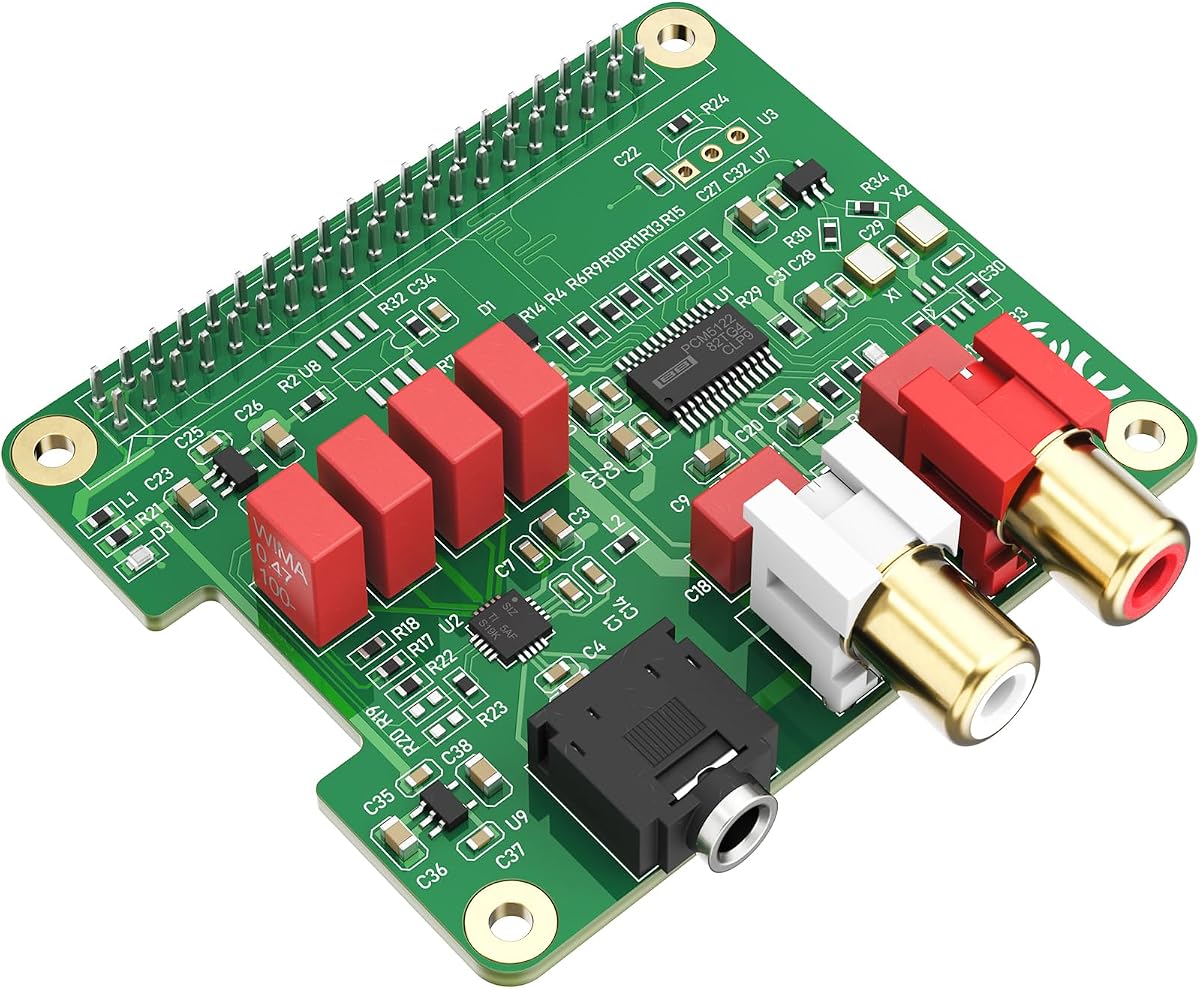
The HiFi DAC HAT stands out as the top choice for most users seeking high-quality audio from their Raspberry Pi. With a solid 4.5 rating, it delivers studio-grade sound through its PCM5122 chip and dual oscillators. This board effectively replaces the weak onboard audio with pristine analog output suitable for serious listening.
We may earn a commission when you buy through this link, at no additional cost to you.
Its key strengths lie in its engineering. The dual ultra-low jitter oscillators ensure accurate timing, while the 112dB SNR provides a clean signal floor. It supports high-res formats up to 384kHz/32bit and works seamlessly with popular players like Volumio and Moode. The onboard EEPROM makes setup incredibly easy for beginners.
Trade-offs include a modest headphone amplifier that might struggle with high-impedance cans. Additionally, it requires access to the 40-pin GPIO header which some users may find inconvenient if they already have a case. However, the sound quality and ease of use make these minor issues acceptable for most.
Anyone looking to turn their Pi into a dedicated music streamer should buy this board. It balances performance and cost better than any other option tested. Whether you connect speakers via RCA or headphones, you get a significant upgrade over standard audio.
The dual oscillators eliminate timing jitter common in standard Pi setups ensuring crystal clear audio reproduction across all frequencies.
With both RCA line-level outputs and a dedicated headphone jack, this board connects easily to any amplifier or speaker system.
We may earn a commission when you buy through this link, at no additional cost to you.
The DAC Mini Hat is specifically engineered for the Raspberry Pi Zero series making it the perfect solution for portable projects. Despite its small footprint, it delivers the same high-performance PCM5122 audio conversion found in larger boards. Users appreciate its ability to stay flush with the board without overhanging edges.
We may earn a commission when you buy through this link, at no additional cost to you.
It supports all major music player systems out of the box ensuring you can start listening immediately. The gold-plated outputs provide reliable connections for RCA cables or headphones. While it lacks some premium features like dual clocks, the sound quality remains impressive for its size and price point.
The main limitation is physical space; fitting a case around a Pi Zero and this HAT can be tricky. The build uses standard materials which feel less robust than premium options. However, for space-constrained builds where audio quality matters, it offers unbeatable value.
Buyers focusing on portable media players or small home theater PCs should choose this model. It proves you do not need a large board to get great sound. Its seamless fit with the Zero series makes it a standout for compact enthusiasts.
This design ensures the HAT sits perfectly on Pi Zero models without blocking ports or sticking out dangerously.
Works with all 40-pin Pi models so you can upgrade later without buying a new audio board.
We may earn a commission when you buy through this link, at no additional cost to you.
The HiFi DAC Pro Hat brings professional-grade audio to the Pi with its flagship ESS ES9038Q2M chip. Rated 4.5 stars, it offers unmatched dynamic range and clarity suitable for critical listening. This model is designed for audiophiles who demand bit-perfect sound and high-resolution playback capabilities.
We may earn a commission when you buy through this link, at no additional cost to you.
It features three TI op-amps driving both standard and balanced outputs allowing connection to high-end gear. Support for DSD512 ensures native playback of the highest quality audio files. The board includes extensive documentation and Wiki support making complex configurations manageable even for beginners.
The higher price reflects its advanced features but may not be necessary for casual listeners. Some users may need an external power source for optimal balanced output performance. Despite this, the sound quality exceeds most competitors in this category significantly.
Serious audiophiles building a dedicated server should invest in this board. The balanced outputs and DSD support future-proof your setup against evolving audio formats. If budget allows, this provides the best possible audio experience on the Pi platform.
The ES9038Q2M chip delivers studio-quality sound with extremely low distortion and high dynamic range for pure audio.
Dedicated balanced outputs reduce interference for professional setups requiring maximum signal integrity and clarity.
We may earn a commission when you buy through this link, at no additional cost to you.
The Digi One Hat is unique as it focuses purely on digital output rather than analog conversion. With a 4.8 rating, it excels at sending pristine audio streams to an external DAC. This makes it ideal for users who already own high-end audio equipment and just need a clean source.
We may earn a commission when you buy through this link, at no additional cost to you.
It features S/PDIF interface with optical and coaxial outputs ensuring compatibility with most amplifiers. The built-in galvanic isolation prevents ground loops which often cause hum in connected systems. Its industrial-grade isolators and low-jitter design ensure accurate timing across all supported formats.
Since it lacks an internal DAC you cannot connect speakers directly to this board. You must have a separate external DAC to use this product effectively. This limitation means it has a smaller target audience but offers superior performance for that specific use case.
Users with existing audio chains or audiophile systems should consider this hat. It transforms the Pi into a transparent digital transport. By isolating the digital signal effectively it ensures your external gear performs at its absolute best without noise interference.
Galvanic isolation blocks noise and interference from the Pi ensuring a pure digital stream to your external equipment.
Compatible with all major Raspberry Pi music players ensuring seamless integration with your existing streaming setup.
We may earn a commission when you buy through this link, at no additional cost to you.
This module offers a straightforward way to upgrade audio on older Pi models like the 2 and 3. With a high rating of 4.8, it is praised for its simplicity and reliability. The PCM5122 chip provides solid sound quality that is a huge leap forward from the internal audio.
We may earn a commission when you buy through this link, at no additional cost to you.
LED indicators help you visually confirm the board status making troubleshooting easier for novices. The IR receiver allows basic remote control functionality for a media player. It supports high sample rates and offers a good SNR for clear sound during playback.
While effective, the design is simpler and less polished than newer HATs. Documentation can be sparse compared to premium brands. For users comfortable with basic GPIO connections, these issues are minor compared to the low cost and immediate performance boost.
Beginners on a budget or those with older Pi hardware should buy this card. It proves you do not need the latest device to get great sound. The visual feedback and low cost make it a safe starting point for audio projects.
LED lights show power and decode status helping you confirm the board is working without complex debugging.
Designed to work well with older Pi models extending the life of existing hardware with modern audio performance.
We may earn a commission when you buy through this link, at no additional cost to you.
The RASPIAUDIO Audio DAC Hat provides a direct upgrade to USB audio sticks with better stability and quality. It claims an impressive 112dB SNR and supports high-resolution PCM playback. The key feature is its onboard EEPROM allowing immediate plug-and-play functionality without complex driver setup.
We may earn a commission when you buy through this link, at no additional cost to you.
It works with all major Pi models from Zero to Pi 5 ensuring long-term usability. The colored PCB adds a touch of aesthetic flair to your build. Audio quality is noticeably cleaner than standard internal or USB options making it a reliable choice for daily listening.
The build is simple and does not include advanced features like balanced outputs. However for the price it offers a significant step up in convenience and sound. The universal support means you do not need to worry about model compatibility when upgrading.
Users frustrated with USB dongles or internal noise should switch to this hat. It simplifies setup significantly while improving fidelity. For general home listening and media centers, it offers a balanced solution between cost and performance.
The EEPROM chip allows instant recognition and operation by the Pi eliminating the need for complex software configuration.
Supports all Raspberry Pi versions from Zero to Pi 5 ensuring longevity as you upgrade your hardware over time.
We may earn a commission when you buy through this link, at no additional cost to you.
This model is specifically designed for the Pi 5 to address common noise issues in newer boards. With a perfect 5.0 rating, users praise its ability to eliminate ground loops via an included isolator. It uses the reliable PCM5122 codec to deliver clean sound without hum or hiss.
We may earn a commission when you buy through this link, at no additional cost to you.
Installation is straightforward with a plug-and-play design that fits the Pi 5 GPIO perfectly. The focus on noise reduction makes it ideal for home theater systems where hum is distracting. It provides a solid stereo output via 3.5mm for immediate use.
The main trade-off is limited output options compared to HATs with RCA or balanced connections. You are restricted to the stereo jack which may limit speaker choices. However, the noise isolation feature solves a critical pain point for Pi 5 audio.
New Pi 5 users seeking a quiet setup should prioritize this DAC. The isolator ensures you get the best possible signal quality from the board. While simple, its effectiveness against noise makes it a top choice for modern hardware.
Built-in ground loop isolation prevents humming ensuring your speakers play only music without electrical interference.
Designed specifically to optimize audio performance on the latest Pi 5 hardware for best compatibility.
We may earn a commission when you buy through this link, at no additional cost to you.
The HiFiBerry DAC+ DSP offers powerful onboard processing for complex audio tasks. Unlike standard boards it includes a Digital Signal Processor capable of room equalization and sample rate conversion. This makes it highly versatile for users needing precise control over their sound output.
We may earn a commission when you buy through this link, at no additional cost to you.
You can adjust DSP parameters on the fly without stopping playback allowing dynamic tuning. The high-quality asynchronous converter ensures accurate timing and prevents distortion. It even functions as a standalone DAC without the Pi for offline playback scenarios.
The price is significantly higher than typical HATs and requires a specific enclosure for use. This limits its appeal to enthusiasts with specific technical needs. However, for custom audio installations needing DSP features, it is one of the few viable options.
Advanced users needing room calibration or complex signal processing should choose this board. It provides tools that software alone cannot offer effectively. If you have specific acoustics to manage this DSP power is invaluable.
The DSP allows real-time signal manipulation enabling features like room correction and advanced audio shaping.
Built-in sample rate conversion ensures clean audio streams regardless of source file formats or speeds.
We may earn a commission when you buy through this link, at no additional cost to you.
This card is a trusted choice for sending digital signals to external amps or DACs. It supports Toslink and Coaxial outputs ensuring flexibility in connection types. With a high rating of 4.6, it is known for preserving audio data perfectly without modification.
We may earn a commission when you buy through this link, at no additional cost to you.
The chip handles up to 192kHz/24bit resolution ensuring high-fidelity transmission. Being bit-perfect means every bit of data remains intact from source to output. This makes it excellent for audiophile setups where signal integrity is paramount.
It focuses on older Pi models like the Pi 2 and B+ so might not suit the latest hardware. Lack of analog output means it only works with external systems. Despite these limits, it remains a benchmark for digital transport reliability.
Users connecting to legacy receivers or high-end DACs should consider this option. Its reliability and support for both connector types make it versatile. For those building a streaming server with external processing, it is a solid foundation.
Ensures audio data remains unchanged during output maintaining the integrity of the original file for pure sound.
Supports both optical and coaxial digital connections making it compatible with a wide range of external gear.
We may earn a commission when you buy through this link, at no additional cost to you.
This module offers the most affordable way to upgrade your Pi audio. With a 4.2 rating, it delivers surprisingly good sound for the price. The PCM5102A chip provides decent conversion and the included soldered stereo jack saves time and hassle for assembly.
We may earn a commission when you buy through this link, at no additional cost to you.
It connects via the standard I2S interface allowing straightforward integration with existing projects. The board is compact and easy to fit into tight spaces. While not feature-rich, it solves the core need of better audio without breaking the bank.
Build quality is basic with minimal additional circuitry compared to HATs. There are no extra features like oscillators or headphone amps. However, for tight budgets or temporary projects, the performance-to-price ratio is unbeatable in the market.
Students or DIY hobbyists on a tight budget should buy this module. It proves high-quality audio does not require expensive gear. If sound quality matters more than features, this is the most cost-effective upgrade you can make.
Offers a significant audio boost for a fraction of the cost of other options on the market.
Soldered stereo jack and simple I2S connections make installation quick and easy even for beginners.
We may earn a commission when you buy through this link, at no additional cost to you.
Selecting the right DAC depends on your specific Pi model, budget, and audio goals. We break down the critical factors to help you make an informed decision.
The DAC chip is the heart of the board and determines sound fidelity. Chips like the PCM5122 offer great value while the ES9038Q2M provides premium performance. Always check the datasheet for signal-to-noise ratio and total harmonic distortion numbers.
Higher quality chips usually mean clearer sound and better resolution support.
Decide if you need analog outputs like RCA or 3.5mm, or digital outputs like S/PDIF. RCA is best for active speakers while digital outputs suit external amplifiers. Some boards offer both for maximum flexibility.
Choose outputs that match your existing speakers or amplifier inputs.
Ensure the HAT fits your specific Pi model. Some boards are optimized for newer Pi 5s or compact Zeros. Verify GPIO header compatibility to avoid physical interference or connection issues.
Check product descriptions for specific model support before purchasing.
The best DACs work seamlessly with popular music players like Volumio or Moode. Look for boards with EEPROM or pre-installed drivers to simplify setup. Community support and documentation are also valuable for troubleshooting.
Prioritize boards with easy plug-and-play configurations.
Timing errors in audio playback can cause jitter and degrade sound quality. Some boards feature external low-jitter oscillators instead of relying on the Pi clock. This detail matters for critical listening.
Look for dual oscillator or master-clock features for better timing.
Solid construction ensures durability and stable connections. Gold-plated connectors and quality capacitors reduce noise. A sturdy PCB design protects components over time and during transport.
Check for quality materials in the connector and mounting hardware.
Prices vary widely from ten-dollar modules to premium hundred-dollar units. Determine how much quality you need versus what you can afford. Budget boards often deliver good results for casual listening.
Balance your financial constraints with your audio requirements.
Some boards offer extras like balanced outputs, DSP processors, or IR receivers. These features add convenience or specialized capabilities. Consider if you actually need these extras before paying more.
Evaluate if bonus features justify the higher price.
To install, power off your Pi first to avoid static damage. Align the GPIO pins carefully and press the HAT down firmly onto the header. Ensure no cables obstruct the airflow or connection points before powering on.
Configure your audio software after booting by selecting the new device in settings. Install recommended music players like Volumio for optimal integration. Keep your software updated to maintain compatibility and performance.
Regularly check connections for dust buildup which can affect sound quality. Avoid moving the board while powered on to prevent physical damage. If using external power supplies ensure they are stable to protect sensitive electronics.
Most modern DAC HATs plug directly into the 40-pin GPIO header without requiring any soldering. Just align the pins carefully and push the board on. However, some older modules may still require basic soldering skills for setup.
Yes, many DACs are designed specifically to fit the Pi Zero compact form factor. Look for models labeled as Zero-friendly to ensure they do not overhang or block ports. Standard 40-pin compatible boards generally work with slight adjustments.
PCM supports standard digital audio formats up to high resolutions like 384kHz. DSD is a format used in SACDs often requiring higher processing power. Support for both ensures you can play the widest range of high-fidelity files.
Most DAC HATs draw sufficient power directly from the Raspberry Pi GPIO pins. High-end boards or those driving high-impedance headphones may benefit from external power to avoid strain on the Pi.
Yes, most support standard operating systems including Android TV. They connect via GPIO or USB so software integration depends on your specific OS version. Check device lists before buying for specific TV OS support.
Noise often comes from ground loops or power issues. Try using a ground loop isolator or upgrading your power supply. Ensure cables are shielded and connections are secure to reduce interference.
We have reviewed ten distinct models ranging from budget modules to premium audiophile boards. Each offers a unique balance of features and value suitable for different projects.
Prioritize sound quality and compatibility with your specific Pi model when deciding. A great DAC transforms your Pi into a legitimate music player capable of high-fidelity playback.
Always check current listings and prices as they change frequently. Our top picks offer the best starting points for most users seeking reliable and clear audio today.